

Call center costs are rising faster than customer expectations are falling. Hiring more agents no longer fixes long wait times, missed calls, or inconsistent support quality.
For most businesses, scaling a traditional call center now means higher spend with diminishing returns.
That is why AI call center software is no longer an experiment. It has become a core operational layer for handling inbound calls, qualifying intent, routing conversations, and supporting agents at scale.
Companies adopting call center AI software are not chasing innovation. They are protecting margins and the customer experience simultaneously.
If you are evaluating call center artificial intelligence software, this blog focuses on what actually matters at decision time.
It breaks down features, real-world use cases, and ROI considerations to help you choose the right platform with clarity and confidence.
Why Businesses Are Replacing Traditional Call Centers With AI
As call volumes increase and customer expectations tighten, many businesses are reassessing how their call centers operate.
Practical constraints around cost, scale, and response speed drive the move toward AI call center software. Traditional call center models struggle to keep pace with these demands.
Rising Support Costs and Agent Burnout
Traditional call centers rely heavily on human agents for every interaction.
What happens in practice
- Agents spend most of their time on repetitive Tier one queries
- Training and ramp-up cycles increase operational cost
- Burnout leads to high attrition and inconsistent service quality
How AI changes this
- Call center AI software handles routine inbound calls
- Human agents focus on complex and high-value conversations
- Teams reduce hiring pressure while maintaining service levels
Inbound Call Spikes and Missed Opportunities
Call volume rarely grows in a predictable pattern.
Common scenarios
- Seasonal demand overwhelms agent capacity
- Marketing campaigns generate unexpected call surges
- Service outages cause sudden inbound spikes
Operational impact
- Missed calls and long wait times
- Lost sales and lower customer satisfaction
AI-driven response
- Call center artificial intelligence software answers calls instantly
- High-intent callers are routed to the right agent
- Volume spikes are handled without adding headcount
Why Legacy IVR and Manual QA No Longer Scale
Older systems were built for low-volume, structured interactions.
Manual quality assurance reviews only a small fraction of calls, leaving gaps in visibility and performance tracking. AI-driven systems analyze every interaction, giving teams consistent insight into call outcomes and agent effectiveness.
Traditional call centers face structural limits in cost control, scalability, and insight generation. This is why businesses are adopting AI-driven call handling as a core operational layer.
The next step is to identify which capabilities set high-performing AI call center platforms apart from basic automation tools.
What High-Performing AI Call Center Software Must Deliver
As businesses replace traditional call handling, evaluation becomes the deciding factor. Not every AI call center software meets production requirements.
High-performing platforms are defined by consistency in conversation handling, system integration, and operational visibility.
The criteria below outline what decision makers should expect from a scalable solution.
Intelligent AI Voice Handling
Voice automation must support real customer conversations.
Operational Expectations
- Callers speak naturally without navigating menus
- The system identifies intent, such as billing, delivery, or scheduling
- Context is retained across follow-up questions within the same call
Business Impact
- Faster call resolution
- Lower call abandonment rates
Smart Call Routing and Escalation
Routing must reduce effort for both callers and agents.
Operational Expectations
- Calls are transferred with full conversation history
- Routing is based on agent skill, language, or urgency
- High-priority calls are handled without unnecessary queue time
Business Impact
- Reduced agent handling time
- Improved first call resolution
CRM and Helpdesk Integration
Conversation data must flow into core systems.
Operational Expectations
- Calls are logged automatically in CRM or helpdesk tools
- Caller identity and interaction history are available in real time
- Tickets are created or updated without manual input
Business Impact
- Consistent customer context across teams
- Lower administrative workload for agents
Real Time Analytics and Call Insights
Measurement must be comprehensive and immediate.
Operational Expectations
- Automatic call summaries are generated for every interaction
- Sentiment analysis applied across all calls
- Performance metrics updated without manual quality checks
Business Impact
- Better visibility into call quality and outcomes
- Faster operational decision-making
Security Compliance and Reliability
Voice systems must meet enterprise standards.
Operational Expectations
- Secure storage of call recordings and transcripts
- Compliance alignment for regulated industries
- High uptime during peak call volumes
Business Impact
- Reduced operational risk
- Reliable customer experience at scale
High-performing platforms are defined by consistent execution across voice handling, routing, data flow, and reliability.
These criteria help eliminate tools that cannot scale in live environments. With these expectations clear, the next step is comparing leading platforms based on real-world performance and deployment fit.
Best AI Call Center Software in 2026
Below is a ranked list of the 11 best AI call center software platforms in 2026, with a strong emphasis on AI voice automation.
Chat and messaging capabilities are included where available, but voice performance remains the primary evaluation factor.
1. BotPenguin
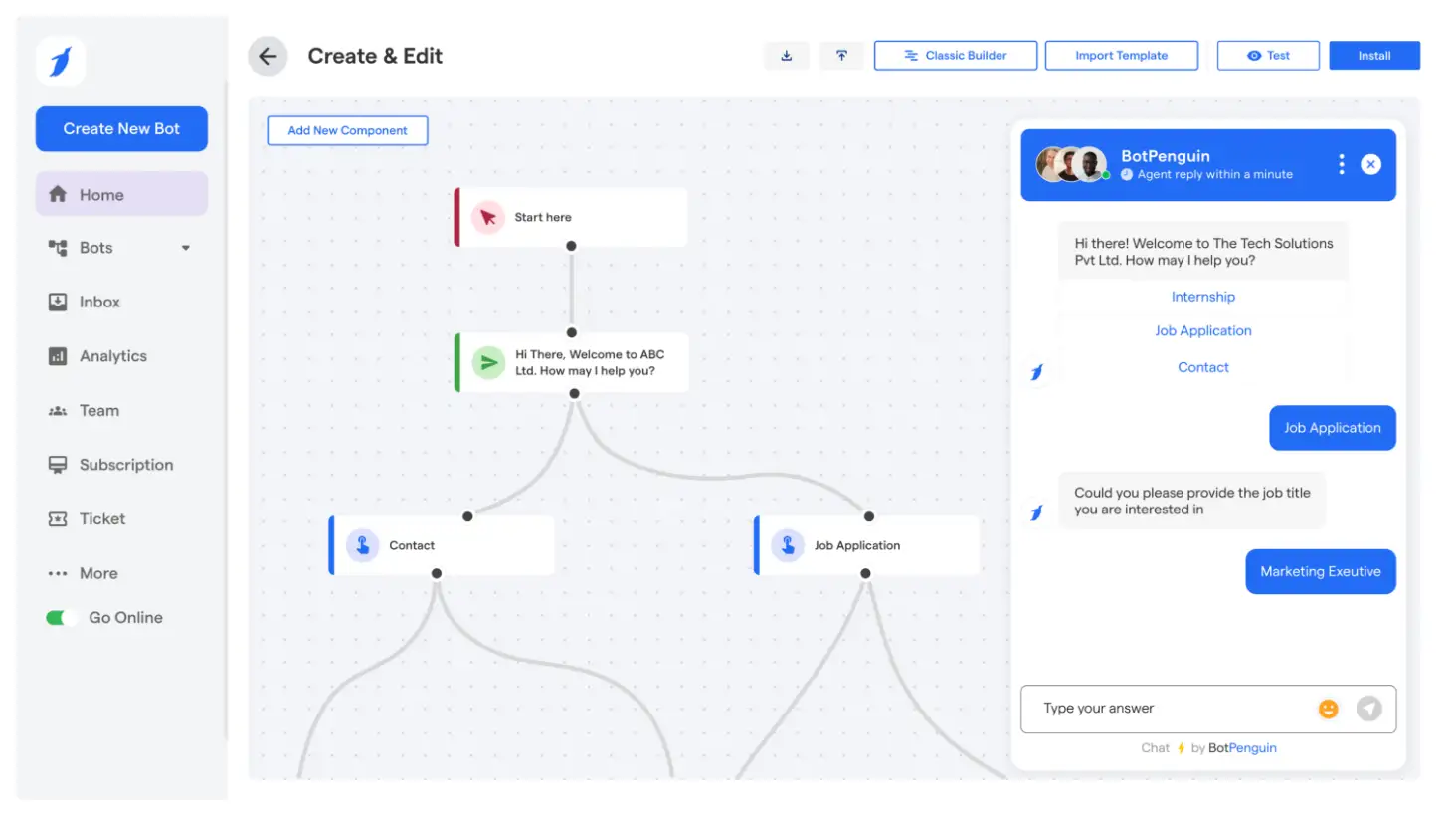
BotPenguin is a no-code AI call center software designed to automate inbound and outbound voice calls while supporting messaging channels from a single dashboard.
It combines AI voice agents, chat automation, and workflow intelligence to handle customer interactions at scale without heavy technical setup.
Key Features
- AI voice agent for inbound and outbound calls
- Unified dashboard for voice, WhatsApp, Instagram, Facebook Messenger, Telegram, and web chat
- Integration with 80-plus CRMs, ticketing, and marketing tools
- Multilingual voice support for global operations
- Real-time call analytics, summaries, and performance tracking
Pros
- Strong AI voice automation with natural conversational flow
- No code deployment is suitable for fast implementation
- Wide integration ecosystem for CRM and internal tools
- Supports both voice and messaging use cases in one platform
- Scales across teams without complex infrastructure
Cons
- Initial configuration required to define call intents and flows
- Advanced analytics and enterprise integrations are available on higher plans
- Ongoing tuning recommended as call volume and complexity increase
Best Use Case
- Automating high-volume routine calls such as appointment scheduling, lead qualification, order confirmations, payment reminders, and customer follow-ups, where instant response is critical.
Ideal Company Size and Industry
- Small to mid-market teams and growing enterprises in healthcare, education, real estate, ecommerce, professional services, and customer support-driven businesses.
Country of Origin
- United States
Try BotPenguin

2. Genesys Cloud CX
Genesys Cloud CX is an enterprise-grade AI call center software built for large-scale customer operations.
It unifies voice and digital interactions while using AI to optimize routing, agent performance, and customer outcomes across complex environments.
Key Features
- AI-driven inbound voice routing and IVR.
- Omnichannel support across voice and digital channels
- Predictive routing and agent assist.
- Workforce management and quality tools
- Open APIs for CRM and enterprise integrations
Pros
- Proven scalability for global operations
- Deep AI embedded across routing and analytics
- Strong compliance and reliability standards
Cons
- Complex setup and administration
- Higher cost as AI and workforce modules are added.
- Requires trained teams for optimal use
Best Use Case
- Managing very large call volumes across regions where routing accuracy, compliance, and workforce optimization are critical.
Ideal Company Size and Industry
- Large enterprises in telecom, banking, insurance, healthcare, government, and global BPOs.
Country of Origin
- United States
3. NICE CXone

NICE CXone is a cloud native call center artificial intelligence software built for large-scale contact centers that require deep analytics, compliance controls, and quality management.
It unifies voice and digital channels into a single platform and applies AI across every interaction to improve resolution quality and operational visibility.
Key Features
- AI-driven IVR and virtual agents for voice and chat.
- Omnichannel support across voice, chat, email, SMS, and social channels.
- Enlighten AI for speech and text analytics across all interactions.
- Workforce optimization, including forecasting, scheduling, and adherence
- AI-based quality management with automated interaction scoring
Pros
- Industry-leading speech and sentiment analytics across one hundred percent of calls
- Strong compliance support for regulated industries
- Integrated workforce management and quality tools
- Scales reliably for large contact centers
Cons
- Interface complexity requires training for agents and administrators.
- Advanced customization often requires technical expertise or professional services.
- Report configuration can be challenging for non-technical users.
- Higher cost to access full omnichannel and analytics capabilities
Best Use Case
- Organizations that require deep visibility into call quality, compliance adherence, and agent performance across high interaction volumes.
Ideal Company Size and Industry
- Large enterprises and BPOs in financial services, insurance, healthcare, government, telecom, and utilities.
Country of Origin
- Israel
4. Five9
Five9 is a cloud-based AI call center software designed to modernize both inbound and outbound voice operations.
It combines intelligent voice automation, predictive dialing, and real-time analytics to improve agent productivity and call outcomes.
Key Features
- AI virtual agents for voice self-service
- Automatic call distribution with skill-based routing
- Predictive, progressive, and preview outbound dialers
- Real-time speech analytics and sentiment detection
- Agent assist and automated quality management
- Native CRM integrations for call logging and screen pops
Pros
- Strong cloud voice reliability and uptime
- Effective outbound calling and campaign management
- Unified agent desktop for voice and digital channels
- Real-time AI insights during live calls
Cons
- The user interface can feel complex for new teams.
- Limited flexibility for highly custom workflows
- Reporting customization may require additional tools.
- Pricing is quote-based and less transparent for small teams.
Best Use Case
- Mid-sized to enterprise contact centers that manage high inbound volumes alongside outbound sales or service campaigns.
Ideal Company Size and Industry
- Mid-market and enterprise teams in financial services, healthcare, retail, ecommerce, technology, telecom, and education.
Country of Origin
- United States
5. Amazon Connect

Amazon Connect is a cloud native AI call center software built on AWS infrastructure. It enables businesses to deploy and scale voice contact centers quickly using a consumption-based pricing model.
The platform emphasizes flexibility, deep customization, and tight integration with AWS AI and data services rather than out-of-the-box contact center completeness.
Key Features
- AI-driven voice IVR using Amazon Lex
- Real-time transcription and sentiment analysis via Contact Lens
- Pay per minute usage-based pricing
- Integration with AWS services such as Lambda, S3, and DynamoDB
- Support for chat channels and custom agent desktops
Pros
- Flexible pricing is well-suited for fluctuating call volumes
- Virtually unlimited scalability across global regions
- Strong AI voice accuracy using AWS speech models
- High security and compliance standards through AWS
Cons
- Advanced use cases require AWS development expertise
- Workforce management and outbound tools often require third-party add-ons
- The default agent interface is basic without customization
- High volume usage can increase costs if not optimized
Best Use Case
- Organizations that want a scalable AI voice system and have internal teams or partners to customize workflows using AWS services.
Ideal Company Size and Industry
- Mid-market to large enterprises in ecommerce, travel, fintech, retail, and technology-driven businesses.
Country of Origin
- United States
6. Twilio Flex
Twilio Flex is a programmable call center artificial intelligence software framework designed for organizations that want full control over voice workflows, routing logic, and integrations.
Rather than providing a ready-made contact center, it offers APIs and SDKs to build a customized solution on top of Twilio’s global voice infrastructure.
Key Features
- Programmable voice call handling and IVR
- API driven routing and task assignment
- Global telephony network with local numbers
- Real-time call data and recordings via APIs
- Integration with third-party AI engines and CRMs
Pros
- Maximum flexibility for custom contact center design
- Strong global voice, reliability, and scale
- Developer friendly ecosystem and documentation
- Suitable for deeply integrated product experiences
Cons
- Requires engineering resources for setup and maintenance
- Longer time to deploy compared to turnkey platforms
- Lacks built-in workforce management and QA tools
- Costs increase with high call volumes and add-ons
Best Use Case
- Organizations that treat the contact center as a product capability and want to build differentiated voice experiences using custom logic and AI.
Ideal Company Size and Industry
- Technology companies, SaaS platforms, fintech, healthcare startups, and BPOs with in-house development teams.
Country of Origin
- United States
7. Talkdesk

Talkdesk is an enterprise-focused AI call center software designed to improve customer experience through AI-driven routing, voice bots, and real-time monitoring.
It provides a structured cloud platform with built-in analytics and industry-specific AI capabilities.
Key Features
- AI voice bots for self-service calls
- Predictive routing based on intent and agent skill
- Real-time sentiment and compliance monitoring
- Agent assists with contextual recommendations
- Omnichannel support with a unified agent desktop
Pros
- Strong AI-driven routing and self-service automation
- Enterprise-grade scalability and reliability
- Built-in analytics and performance dashboards
- Industry-specific AI models for faster deployment
Cons
- AI configuration and tuning require setup effort
- Advanced features are available on higher pricing tiers
- It can be complex for smaller or less structured teams
- Less flexible than fully programmable platforms
Best Use Case
- Large or fast-growing organizations that want built-in AI to improve call resolution, routing efficiency, and service quality without building custom systems.
Ideal Company Size and Industry
- Mid-market and enterprise teams in telecom, financial services, retail, healthcare, travel, and BPOs.
Country of Origin
- United States
8. Dialpad AI Voice
Dialpad AI Voice is a cloud-based AI call center software focused on real-time voice intelligence. It combines business telephony and contact center functionality with built-in AI for transcription, sentiment analysis, and agent coaching.
The platform emphasizes ease of use and rapid deployment over deep customization.
Key Features
- Real-time call transcription and voice recognition
- AI-generated call summaries and action items
- Live agent coaching and sentiment detection
- IVR and skills-based routing
- Omnichannel support, including SMS and messaging
- Native integration with Google Workspace and Microsoft 365
Pros
- Accurate real-time transcription across all calls
- Fast deployment with minimal configuration
- Strong visibility into call content and agent performance
- Unified phone system and contact center in one interface
- Well-suited for remote and distributed teams
Cons
- Limited flexibility for complex routing or workflows
- Developer extensibility is restricted compared to API first platforms
- Advanced AI analytics are available on higher plans
- Performance depends on the internet quality
Best Use Case
- Teams that want immediate insight into call quality and agent performance without complex setup or engineering effort.
Ideal Company Size and Industry
- Small to mid-sized teams in SaaS, sales, professional services, education, and customer support-driven businesses.
Country of Origin
- United States
9. PolyAI

PolyAI is a specialized call center artificial intelligence software focused entirely on conversational voice agents.
It replaces traditional IVR systems with AI voice assistants capable of handling complex, multi-step customer conversations while retaining full context across the call.
Key Features
- Conversational AI voice agents with multi-turn dialogue handling
- Advanced natural language understanding with context retention
- Seamless handoff to human agents with conversation context
- Secure API integrations with backend systems
- Multilingual and accent-aware voice support
Pros
- Highly natural and human-like voice interactions
- Handles complex conversational flows without scripted menus
- Strong context memory throughout long calls
- High call containment rates for routine requests
- Enterprise-grade security and compliance support
Cons
- Requires significant design and implementation effort
- Longer onboarding and tuning timelines
- Primarily voice-focused with no native chat component
- Pricing and deployment are suited mainly for large enterprises
Best Use Case
- Enterprises that want to replace IVR menus with natural conversational AI to resolve a high percentage of inbound calls without agents.
Ideal Company Size and Industry
- Large enterprises in banking, insurance, telecom, travel, hospitality, utilities, and public sector services.
Country of Origin
- United Kingdom
10. Google Cloud Contact Center AI
Google Cloud Contact Center AI is a call center AI software platform centered on building advanced voice bots and agent assist systems.
It provides best-in-class natural language understanding and integrates into existing contact center infrastructure rather than replacing it entirely.
Key Features
- Dialogflow CX for multi-turn voice bot creation
- Advanced intent detection and context handling
- Real-time agent assists with transcription and suggestions
- Sentiment analysis and conversation insights
- Integration with existing contact center platforms
- Usage-based pricing model
Pros
- Industry-leading natural language understanding
- Strong multilingual support and voice quality
- Visual conversation flow builder for complex logic
- Scales easily across global call volumes
- Flexible integration with existing systems
Cons
- Not a full contact center solution by itself
- Requires conversational design and technical expertise
- Usage-based costs can grow with high volume
- Complex deployments need multiple systems working together
Best Use Case
- Organizations that want to deploy advanced AI voice bots or agent assist on top of an existing contact center platform.
Ideal Company Size and Industry
- Mid-market to large enterprises in retail, finance, telecom, utilities, travel, and global customer support operations.
Country of Origin
- United States
11. Cisco Webex Contact Center
Cisco Webex Contact Center is an enterprise-grade AI call center software combining cloud telephony, omnichannel routing, and AI-driven agent assistance.
It is designed for organizations that require reliability, security, and deep integration with existing enterprise systems.
Key Features
- AI-powered IVR and conversational voice bots
- Real-time agent assists with transcription and suggestions
- Automated call summaries and after-call insights
- Omnichannel routing with unified agent desktop
- Workforce optimization and experience management
- Enterprise security and compliance controls
Pros
- Proven voice reliability at a large scale
- Strong security and compliance capabilities
- Integrated AI for both customer self-service and agents
- Unified view of customer interactions across channels
- Well-suited for regulated industries
Cons
- Complex deployment often requires certified partners
- Premium pricing structure
- Overkill for small or simple contact center setups
- Migration from legacy Cisco systems can require planning
Best Use Case
- Large enterprises that need a secure, reliable, AI-enabled contact center with deep control and compliance.
Ideal Company Size and Industry
- Large organizations in finance, healthcare, government, telecom, utilities, and global enterprises.
Country of Origin
- United States
These AI call center platforms span a wide range of operational models, from enterprise-grade systems to highly configurable and usage-based solutions.
Selecting the right platform depends on business scale, technical maturity, compliance requirements, and the role automation plays in long-term efficiency.
Common Concerns About AI Call Center Software
After reviewing leading platforms, most buyers pause at the same set of concerns. These questions are practical and tied to real operational risk.
Addressing them clearly is essential before moving from evaluation to adoption. AI call center software decisions are rarely blocked by features. They are blocked by uncertainty around people, performance, and cost.
Will AI Replace Human Agents
AI is designed to reduce overload, not eliminate teams.
What happens in real environments
- AI answers repetitive inbound calls such as order status, appointment confirmation, or basic account queries.
- Human agents receive fewer low-value calls and handle complex or emotional conversations.
Operational outcome
- Agents spend more time on problem-solving and customer retention
- Attrition reduces because work becomes less repetitive
- Call center AI software functions as a front-line filter, not a replacement layer
In practice, companies deploy AI to protect agent capacity, not remove it.
Can AI Handle Real Customer Conversations
AI performs best in structured and repeatable scenarios.
Where AI works best
- High volume FAQs
- Lead qualification and routing
- Payment reminders and delivery updates
- Appointment scheduling and rescheduling
When humans step in
- Billing disputes
- Escalations involving frustration or exceptions
- Policy decisions and negotiation
Modern call center artificial intelligence software transfers calls with full context. Agents do not restart conversations. This handoff model is what makes AI usable in live environments.
Is AI Call Center Software Expensive?
Cost concerns usually come from comparing AI to legacy tools instead of hiring.
Cost comparison
- One AI voice agent can handle thousands of calls per month
- Hiring requires salary, training, management, and attrition replacement
- AI cost remains stable as volume increases
Long-term ROI logic
- Reduced cost per call
- Faster response times without added headcount
- Improved customer satisfaction through instant availability
Over time, AI call center software shifts spend from variable labor cost to predictable operational cost.
Most objections stem from outdated assumptions about automation. AI does not replace teams, struggle with real conversations, or inflate costs when deployed correctly.
With concerns addressed, the focus shifts to how businesses should choose the right platform based on scale, use cases, and expected outcomes.
Why BotPenguin is Built for Modern AI Call Centers
After evaluating platforms and ROI drivers, the final decision often comes down to operational fit.
Teams need AI call center software that delivers results quickly without locking them into rigid systems. BotPenguin is designed around how modern call centers actually operate, not around abstract feature checklists.
Unified AI Voice and Chat Platform
Most customer conversations do not stay limited to voice. BotPenguin brings voice calls and chat channels into one system.
How this works in practice
- A customer calls for order status and later follows up on WhatsApp
- Conversation history is preserved across channels
- Agents see full context regardless of entry point
This unified approach allows call center AI software to support real customer journeys instead of isolated interactions.
Fast Deployment Without Heavy IT Effort
Speed to value matters at the decision stage.
Operational advantage
- No code setup for common voice use cases
- Minimal dependency on engineering teams
- Faster launch for appointment calls, lead qualification, and FAQs
For example, a service business can deploy AI call handling within days instead of months.
Scales From SMBs to Enterprises
BotPenguin is designed to grow with usage.
Scalability characteristics
- Supports small teams handling hundreds of calls
- Expands to large volumes without replatforming
- Pricing aligned with usage rather than fixed headcount
This makes call center artificial intelligence software viable early without becoming restrictive later.
Balanced Automation Plus Human Control
Automation works best when humans stay in control.
How is balance maintained
- AI handles predictable conversations
- Agents receive calls with full context when escalation is needed
- Supervisors retain visibility and override options
This balance prevents over-automation while protecting agent productivity.
BotPenguin focuses on practical deployment, flexible growth, and controlled automation. These qualities align closely with the operational realities discussed earlier.
The final step is understanding how the right platform choice impacts long-term growth and efficiency.
Explore Now
Final Thoughts
AI-driven call centers are no longer experimental investments. They are operational tools that influence cost structure, service speed, and customer retention. The right AI call center software becomes a growth lever when it reduces friction rather than adding complexity.
Long-term value comes from platforms that scale predictably, adapt to new use cases, and support both automation and human expertise. Short-term feature advantages matter less than sustained operational outcomes.
As buyers evaluate options, the focus should remain on measurable results. Faster response times. Lower cost per call. Better agent utilization. Platforms that deliver on these outcomes consistently will define the next generation of call center performance.
Frequently Asked Questions (FAQs)
What Are AI Call Center Solutions, and When Should Businesses Adopt Them?
AI call center solutions use automation and AI to handle voice calls, routing, and repetitive queries.
Companies should adopt them when call volumes increase, response times deteriorate, or agent workload grows despite stable demand.
How Do Call Center AI Solutions Improve ROI Compared to Traditional Call Centers?
Call center AI solutions reduce cost per call by automating routine interactions, improving first-call resolution, and reducing agent overtime.
Over time, they allow teams to scale support volume without increasing headcount or operational overhead.
How Does an AI Call Center Solution Work Alongside Human Agents
An AI call center solution handles predictable requests and collects context before escalating complex calls to agents.
This improves agent productivity, reduces repetition, and ensures humans focus on judgment-based conversations rather than routine tasks.
Are AI in Call Center Solutions Reliable for Honest Customer Conversations
Modern AI in call center solutions uses intent detection, confidence scoring, and human fallback rules.
When AI confidence is low, calls are automatically transferred to agents, ensuring service quality is maintained without risking customer frustration.
Why is BotPenguin a Practical AI Solution for Call Center Automation
BotPenguin is an AI solution for a call center platform designed for gradual adoption.
It allows teams to automate specific call types first, maintain human control, and scale only after results are proven, making it suitable for ROI focused businesses.