WhatsApp Chatbot for Ecommerce: Use Cases, Examples, and Setup
Updated at Sep 14, 2026
12 min to read
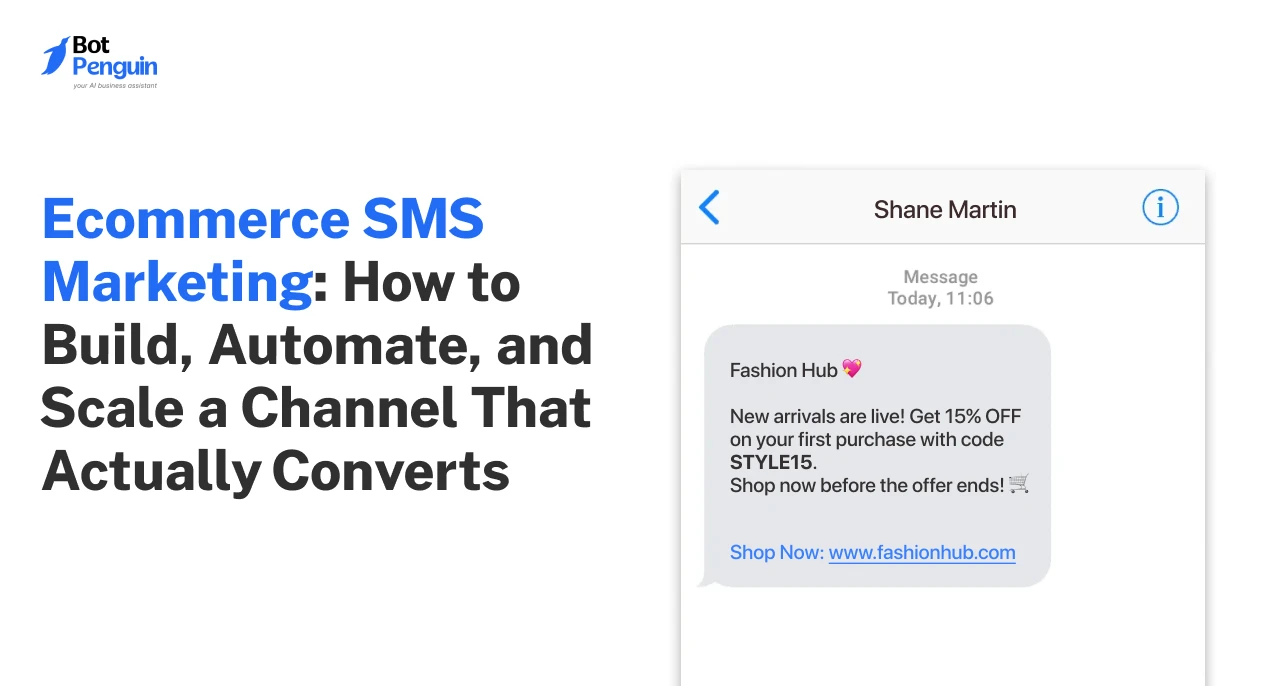
Most ecommerce brands treat SMS like a megaphone. Blast a discount. Wait for clicks. Repeat.
That's not a strategy. That's a shortcut to gaining unsubscribes.
This is where ecommerce SMS marketing comes in as a more structured approach to using SMS as a retention and revenue channel.
In fact, ecommerce SMS marketing has become one of the highest-ROI retention channels, with open rates reaching 98 percent (Gartner, Mobile Marketing Watch).
Because the brands winning with SMS aren't sending more, they're sending smarter.
This guide breaks down how to build, automate, and scale SMS marketing for ecommerce, covering campaign types, automation frameworks, platform comparisons, and compliance, so you can turn it into a reliable revenue channel.
Ecommerce SMS marketing is the practice of sending permission-based text messages to customers to promote products, share updates, and drive purchases.
It works as a direct-to-consumer channel, delivering messages straight to a customer’s mobile device without relying on algorithms or inbox placement.
At its core, it is built on behavior-driven communication, where messages are triggered by customer actions such as signing up, browsing, purchasing, or becoming inactive. This makes each message timely, relevant, and tied to real intent rather than generic broadcasting.
In simple terms, SMS gives ecommerce brands a direct and behavior-driven way to communicate with customers at the right moment.
Many ecommerce brands now automate SMS marketing using AI chatbots and workflows. This allows messages to be triggered by real customer actions rather than manual campaigns.
Platforms like BotPenguin make this easier by combining SMS with AI-driven automation across the customer journey.
Now, let’s look at how it performs compared to other marketing channels.
Not all retention channels compete on the same level. SMS stands out because it delivers messages directly to the most attention-rich device customers use every day: their phone.
When compared across key engagement metrics against other retention channels, the difference is clear:
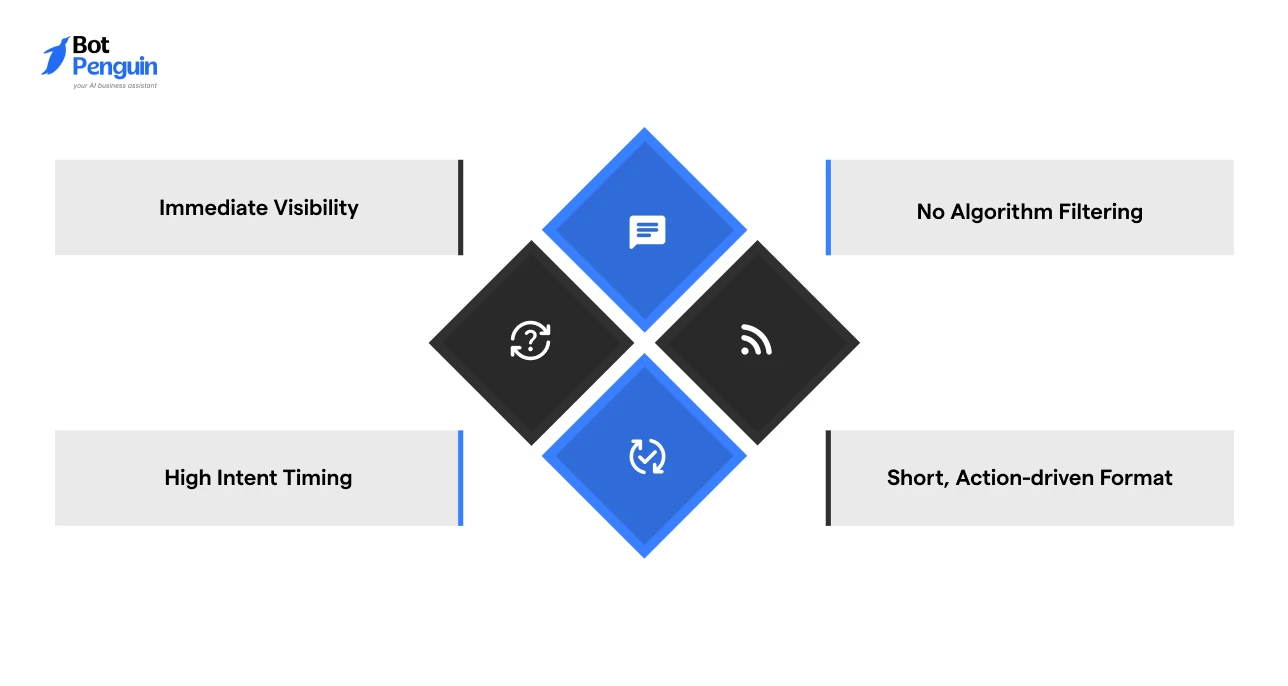
SMS complements other channels by handling time-sensitive, high-intent interactions where speed and visibility matter most.
At this stage, it's worthwhile to look at the specific types of SMS campaigns that actually drive these results.
Ecommerce brands should run SMS campaigns across five core types: abandoned cart recovery, welcome series, post-purchase and winback flows, promotional campaigns, and loyalty messaging.
Each type targets a specific stage in the customer journey and drives a defined outcome, from immediate conversions to long-term retention.
Abandoned cart SMS campaigns recover lost sales by targeting users who showed purchase intent but did not complete checkout.
How it works:
Message structure: Reminder → urgency → optional incentive
Example: Home essentials brand Brooklinen sends simple reminders with subtle urgency, avoiding heavy discounts unless needed.
Sample message: “You left something behind. Complete your order now before it sells out: [link]”
Expected outcome: Recovers 10-20% of abandoned carts (Klaviyo, Omnisend benchmarks)
Welcome series SMS campaigns engage new subscribers immediately after opt-in and drive their first purchase.
How it works:
What to include:
Example: Fitness apparel brand Gymshark combines its brand tone with a first-order incentive to drive immediate conversion.
Sample message: “Welcome to Gymshark. Here’s 10% off your first order: [code]. You’ll also get early access to drops.”
Expected outcome: Drives 20-30% conversion rates for first-time purchases (Attentive SMS Benchmarks)
Post-purchase and winback SMS campaigns increase customer lifetime value by building trust after purchase and re-engaging inactive users.
Post-purchase use:
Winback triggers: No purchase in 30-60 days
Example: Sustainable footwear brand Allbirds uses post-purchase messages to reinforce brand experience and later re-engage inactive buyers.
Sample message (winback): “It’s been a while. Here’s 15% off your next pair: [link]”
Expected outcome: Improves retention and reactivates 5-10% of inactive customers (Omnisend, Campaign Monitor)
Promotional ecommerce SMS campaigns drive immediate conversions by using urgency and time-sensitive messaging.
When to use:
Example: Fast-fashion brand Fashion Nova runs high-frequency, urgency-driven SMS campaigns tied to flash sales.
Sample message: “Back in stock. Your favorite item is live again. Shop now before it sells out: [link].”
Expected outcome: Generates 2-5x higher conversion rates vs email for time-sensitive campaigns (Attentive, Klaviyo)
Loyalty SMS marketing campaigns increase retention by rewarding repeat customers with exclusive access and offers.
How it works:
Example: Beauty and skincare brand Glossier uses SMS to give VIP customers early access to product launches.
Sample message: “VIP access unlocked. Shop our new drop before anyone else: [link].”
Expected outcome: Increases customer lifetime value with 15-25% higher repeat purchase rates among engaged segments (Smile.io, Yotpo loyalty data)
These campaign types define how SMS is used across the customer lifecycle, from acquisition to retention. But handling them manually becomes difficult with every passing day.
So, let’s understand how to automate these campaigns so they run consistently and scale without manual effort.
Automating SMS marketing for your online store using AI means setting up trigger-based workflows that adapt based on customer behavior and intent.
Unlike traditional automation, which follows fixed rules, AI enhances these workflows by improving timing, personalization, and follow-ups.
This turns SMS marketing from a static system into a more responsive and context-aware communication channel.
Every SMS workflow is built on four core components: trigger, message, timing, and follow-up. AI strengthens each step without changing the core structure.
This structure keeps the workflow simple while allowing AI to enhance relevance, timing, and decision-making at every step.
AI-powered SMS automation depends on real-time ecommerce data to work effectively.
Key data inputs:
These inputs do not need to be managed manually. Once integrated with your ecommerce platform, AI systems automatically pull and process this data to trigger relevant messages in real time.
This allows SMS workflows to respond to actual customer intent instead of fixed rules.
Platforms like BotPenguin combine this data with AI chatbots and automation to trigger relevant messages across the customer journey.
Next, it’s important to understand how to optimize these workflows to maximize performance and revenue.
SMS automation for ecommerce businesses does not stop at setting up flows.
With AI, these workflows become more flexible, helping improve targeting, timing, and messaging based on customer behavior.
To increase revenue, ecommerce brands need to move beyond static automation and use AI-assisted segmentation, channel coordination, and testing to improve performance over time.
AI-assisted segmentation helps tailor SMS messages based on customer behavior and available data, not just fixed rules.
Key segmentation layers:
Where AI adds value:
Why it matters: Segmented campaigns drive up to 760% more revenue than non-segmented campaigns (Campaign Monitor).
Example:
Segmentation ensures every SMS feels relevant, increasing both engagement and conversion rates.
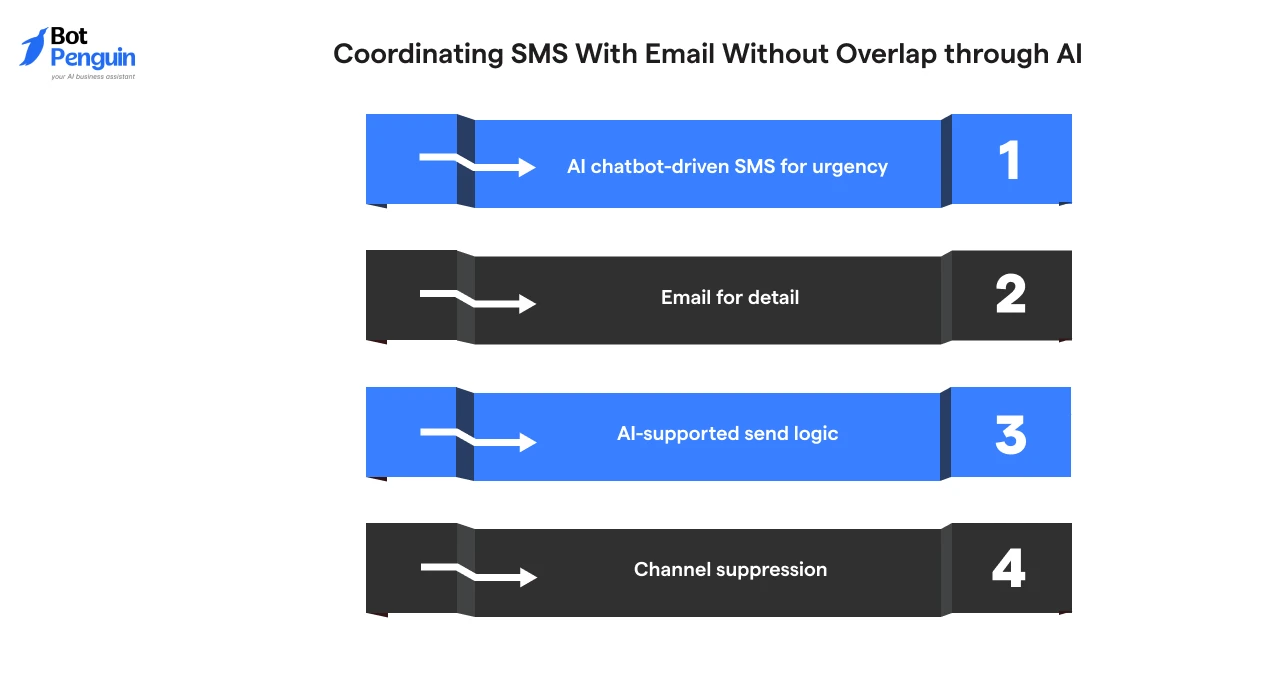
AI helps coordinate SMS and email by deciding which channel to use, when, and for whom, based on user behavior and engagement patterns.
How to coordinate:
Why it matters: Brands using omnichannel strategies see up to 287% higher purchase rates (Omnisend).
This reduces fatigue while ensuring each message is delivered through the most effective channel.
AI-assisted A/B testing helps analyze results faster and improve messaging over time by identifying winning variations based on real performance data.
What to test:
Where AI adds value:
How to evaluate:
Why it matters: Optimized messaging can improve performance by 20-30% over time (Klaviyo benchmarks)
These strategies turn SMS automation from a static setup into a more efficient and continuously improving revenue channel.
At this stage, let’s look at the prominent best practices that ensure these campaigns remain effective without harming the customer experience.
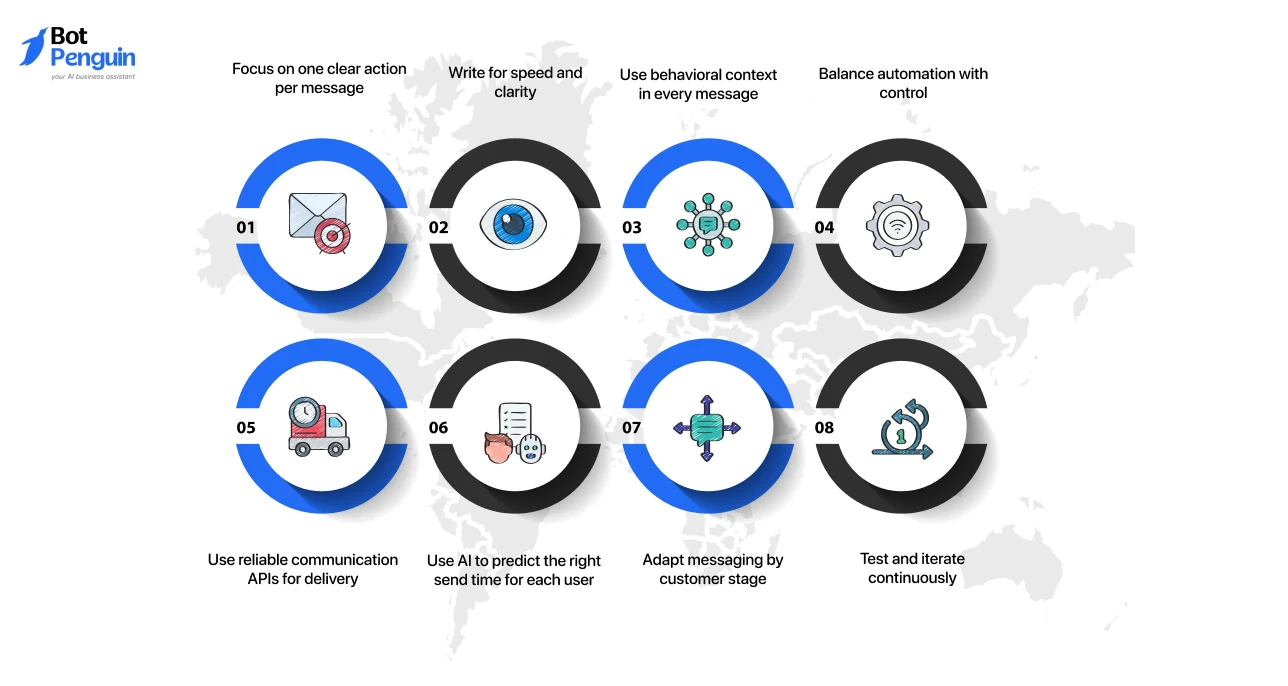
SMS is a high-attention channel, but misuse leads to fast opt-outs and reduced trust. These SMS marketing best practices in ecommerce separate high-performing brands from those that subscribers ignore.
These practices ensure your SMS campaigns stay focused, relevant, and action-driven, leading to stronger conversions over time.
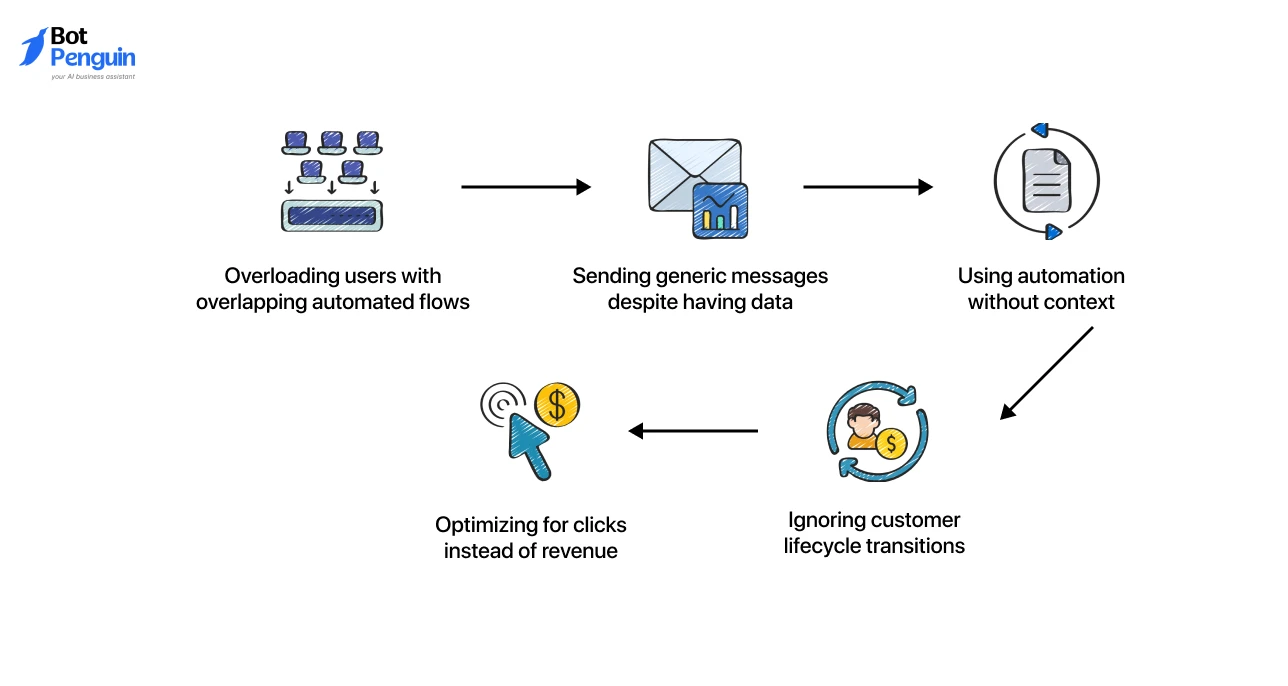
Most ecommerce brands don’t fail at SMS because they ignore best practices. They fail because they don’t use automation and AI to its full potential or apply it without the right context.
When these fundamentals are handled well, AI-driven SMS automation becomes a consistent and scalable revenue channel for ecommerce business.
The next consideration is ensuring everything you send stays compliant with legal requirements across regions.
SMS marketing is regulated across regions, but most laws follow the same principles: user consent, transparency, and control.
Following global standards in your ecommerce SMS marketing automation campaigns ensures compliance across markets.
Following these standards keeps your automated SMS marketing campaign compliant and scalable across regions.
Choosing the right SMS marketing service for ecommerce depends on how well the platform supports your growth, automation needs, and store integration.
Not all tools are built the same, and selecting the wrong one can limit both performance and scalability.
The right platform should align with your current stage while supporting future expansion without requiring a switch later.
Once you understand these criteria, it becomes easier to compare the top SMS marketing automation platforms for ecommerce and identify which one best fits your business.
Not all SMS tools are built for ecommerce automation. The platforms below support trigger-based workflows, store integrations, and revenue-driven messaging, with many offering AI-assisted features.
For a deeper breakdown, feature comparison, and platform-level analysis, refer to the detailed platform guide.
This comparison gives you a clear starting point to evaluate tools based on automation strength and ecommerce fit.
Each platform differs in the level of automation and data capabilities, including how they support AI-assisted messaging, which directly affects how effectively you can scale SMS revenue.
The next step is understanding how to measure performance and continuously optimize your SMS campaigns.
Measuring SMS performance comes down to tracking a few key metrics that directly reflect delivery, engagement, and revenue impact. Without these, it’s difficult to know what’s working and where to optimize.
Build an Iteration Loop: Track → Analyze → Test → Improve → Repeat
This continuous loop ensures your SMS campaigns improve over time, supported by insights from automated workflows and performance data.
For better results, it also helps to align these optimizations with the best practices covered earlier.
SMS marketing stands out for its directness, immediacy, and ability to drive action. When combined with the right campaigns, AI-assisted automation, and data-driven targeting, it evolves into a reliable revenue channel rather than just a messaging tool.
However, there is no single right way to implement automated ecommerce SMS marketing.
The best approach depends on your audience, store size, and how effectively you use automation and data to guide your messaging strategy.
If you’re getting started, focus on setting up a few high-impact automated flows and refine them over time.
Platforms like BotPenguin help simplify this by combining SMS with AI-driven automation and ecommerce integrations, making it easier to turn engagement into measurable revenue.
SMS marketing for ecommerce uses text messages to promote products, send updates, and automate customer communication, driving conversions and retention.
Yes. SMS marketing achieves high open rates (90%+), fast response times, and strong conversion rates, making it one of the most effective retention channels for ecommerce.
Start by collecting opt-ins, setting up key flows like cart recovery and welcome messages, and using an SMS automation platform integrated with your ecommerce store.
Costs depend on volume and region, typically ranging from $0.01 to $0.05 per message. Pricing scales based on usage and platform features.
Most brands send 2 to 6 messages per month. Increase frequency only for high-intent users or time-sensitive campaigns to avoid fatigue.
A typical SMS conversion rate ranges from 1% to 5%, depending on targeting, timing, and the type of campaign.
Focus on cart recovery, order updates, promotions, winback campaigns, and loyalty messages. Each message should have one clear action.
The best platform depends on your needs. Tools like BotPenguin help automate SMS workflows and integrate with ecommerce data to scale engagement and revenue.
Automate Ecommerce SMS Marketing
Turn SMS into a revenue channel with automated campaigns, targeting, and real-time triggers using BotPenguin.
Start NowCheckout our related blogs you will love.
Updated at Sep 14, 2026
12 min to read
Updated at Jun 29, 2026
11 min to read
Updated at May 29, 2026
11 min to read
Updated at May 27, 2026
9 min to read
Updated at May 20, 2026
8 min to read
Updated at May 20, 2026
9 min to read
Table of Contents