


Care hasn’t kept pace with convenience.
In healthcare, patients still wait for basic responses, and simple tasks often take longer than they should. Delays, manual processes, and fragmented communication continue to slow down care delivery.
This is where healthcare virtual assistants, powered by artificial intelligence, are starting to make a real impact.
By helping providers handle routine tasks faster and more efficiently, these systems reduce manual work, improve communication, and support smoother patient journeys.
What is a Healthcare Virtual Assistant? A Brief Overview
A healthcare virtual assistant is a human or AI-powered solution that helps healthcare providers manage routine tasks and patient interactions efficiently.
It works across chat, voice, or apps to handle everyday activities such as:
- Real-time patient conversations
- Seamless appointment booking and management
- Routine workflows and everyday requests
For example, a patient messages a clinic late at night to book an appointment. The virtual assistant, often powered by an AI chatbot, instantly responds, checks available slots, schedules the visit, and sends a confirmation without human involvement.
In simple terms, a healthcare virtual assistant acts as an always-on support system that works for your comfort, lowering manual effort and helping care teams focus more on patient care.
How AI Healthcare Virtual Assistants Work: Understanding the Process
While some might think virtual health assistants simply reply to messages, the process to handle healthcare interactions is much more structured and intelligent than it seems.
Here’s the big picture of how it works:
- User Initiates Interaction: A patient or staff member starts a conversation via chat, app, or voice.
- Input is Captured and Understood: The system processes text or speech to understand the request.
- Request is Analyzed and Categorized: The assistant identifies intent (e.g., booking, query, billing).
- Action is Triggered Based on Intent: The virtual assistant in healthcare performs the required task, such as scheduling or answering queries.
- Systems and Tools are Integrated: They connect with EHRs, calendars, billing systems, or CRMs.
- Response is Delivered to the User: The assistant then shares a clear, real-time response.
- Escalation to Human Staff When Needed: Complex or sensitive cases are handed off to human teams.
- Continuous Learning and Optimization: The system improves over time using data and interactions.
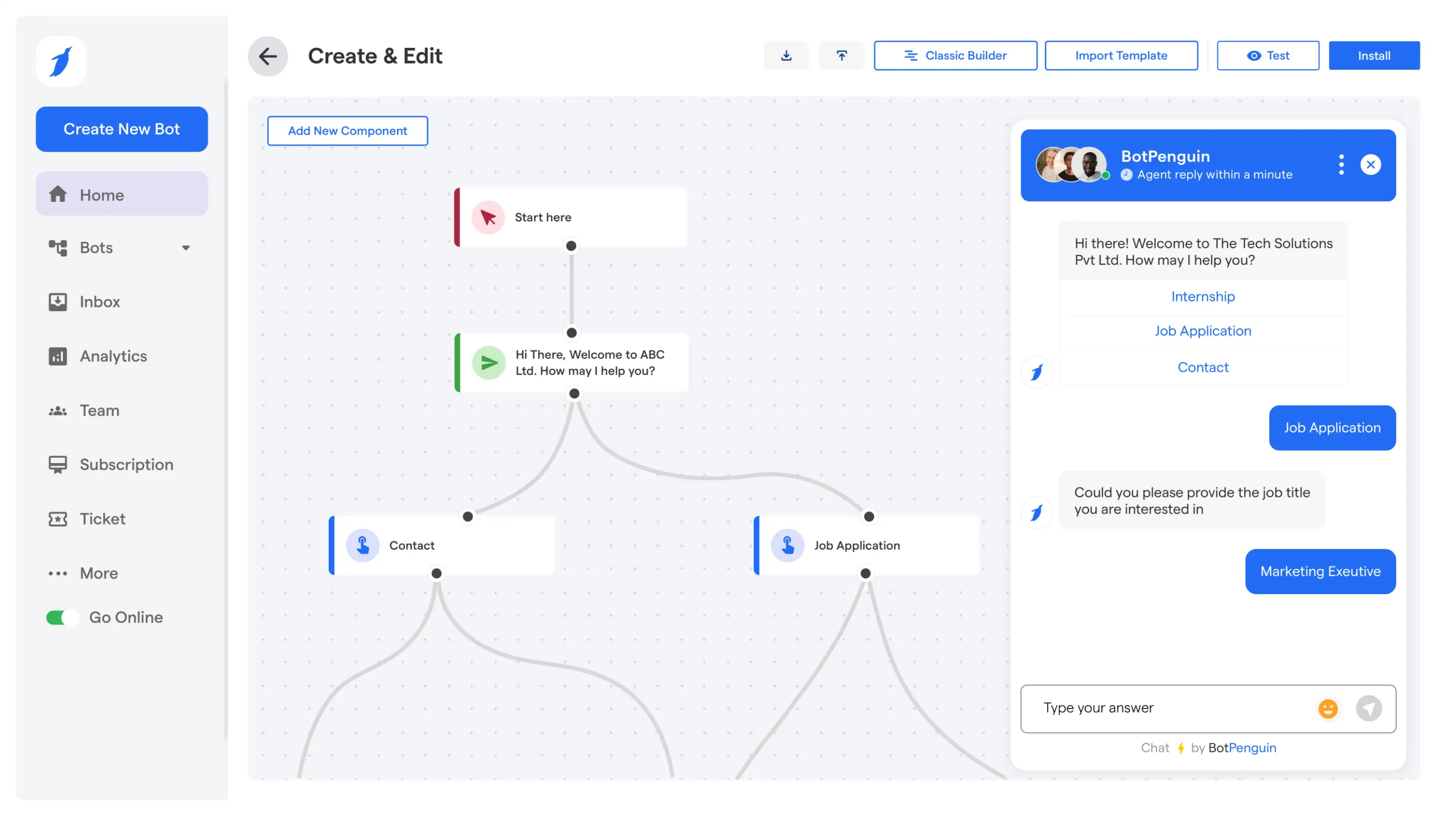
This is where AI chatbots play a key role. Platforms like BotPenguin help healthcare teams build custom AI chatbots that follow this entire process, from understanding patient intent to triggering real actions across systems.
At this stage, it’s also worth noticing that not all virtual assistants do the same thing. In the next section, we’ll explore the most prominent kinds of healthcare digital assistants that are transforming the industry.
7 Types of Healthcare Virtual Assistants Transforming Care
Virtual assistants in healthcare come in different forms based on how they function and what they handle.
We’ve broken them down for you in 7 distinct categories:
Human Virtual Medical Assistants
Remote professionals who support providers with administrative and basic clinical tasks like scheduling, billing, and documentation.
Think: A person managing patient intake from the Philippines, for a hospital in New York
AI Healthcare Virtual Assistants
AI-powered systems that automate patient interactions and routine workflows, enabling faster, scalable support without human involvement.
A prime example of this is Dot by Included Health, a personalized AI assistant that provides members with an always-on, clinician-in-the-loop experience.
Chat-Based Virtual Assistants
Text-based assistants like AI chatbots engage patients via websites, apps, or messaging platforms to answer queries and manage requests.
Cipla, a leading pharmaceutical company, implemented BotPenguin’s chatbot to automate patient reminders, managing 10,000+ campaigns and reducing missed doses by 40%.
Voice-Based Virtual Assistants
Assistants that use voice to handle calls, send reminders, and guide patients through simple processes.
Similar to how tools like Siri or Alexa respond to voice commands, healthcare voice assistants can interact with patients over phone calls or smart devices to support basic care workflows.
Luma Health’s AI-enabled voice concierge lets patients schedule, cancel, or join a waitlist via voice, with near-real-time EHR sync to keep provider calendars accurate.
Administrative Virtual Assistants
Focused on front-desk operations such as appointment booking, insurance verification, and billing support.
Tools like Klara can handle administrative tasks like scheduling, intake, reminders, and insurance checks, so front-desk staff don’t have to.
Clinical Support Virtual Assistants
Designed to assist with care delivery tasks like medical documentation, scribing, and patient data capture.
Example: Suki AI, an ambient clinical intelligence platform that listens to doctor-patient conversations and auto-generates structured clinical notes, ICD-10 codes, and orders directly into the EHR.
Virtual Assistants for Specialty Practices
Custom-built assistants tailored for specific specialties like dental, dermatology, or mental health align with unique workflows and needs.
Platforms like MEDVA match practices with VAs trained in specialty-specific billing, documentation, and scheduling, with no EHR switching required.
A Quick Glance at the Types of Virtual Assistants in Healthcare Industry
What Can a Healthcare Virtual Assistant Actually Do?
An AI virtual assistant in healthcare helps providers automate everyday tasks that slow down care delivery.
From front-desk work to patient engagement, these healthcare digital assistants support multiple functions across the workflow:
- Appointment Scheduling and Calendar Management: Books, reschedules, and manages appointments in real time, reducing back-and-forth and no-shows
- Patient Communication and Query Handling: Answers common questions, shares information, and provides instant responses across chat or voice
- Insurance Verification and Billing Assistance: Checks coverage, verifies details, and assists with billing-related queries to reduce admin burden
- Medical Documentation and Scribing: Captures patient interactions and converts them into structured notes for faster record-keeping
- Patient Intake and Data Collection: Collects patient details, medical history, and forms before appointments, saving staff time
- Follow-Ups and Care Coordination: Sends reminders, follow-ups, and care instructions to keep patients engaged post-visit
Overall, a virtual assistant in the healthcare industry acts as an always-on support layer, especially valuable for high-volume clinics and virtual assistants for specialty practices with complex workflows.
Healthcare Virtual Assistants vs Chatbots vs AI Agents: Key Differences Explained
Healthcare virtual assistants, chatbots, and AI agents are often used interchangeably, but they are not the same. Each plays a different role in how healthcare tasks are handled, from simple conversations to complex, autonomous workflows.
Here’s a clear breakdown of how virtual assistants for healthcare professionals compare in real-world use.
Key Takeaways
- Virtual assistants are broader; they manage workflows, not just conversations.
- Chatbots are a subset, focused on conversational interactions.
- Virtual assistants assist and execute tasks within predefined workflows.
- AI agents independently make decisions and drive those workflows end-to-end.
- Most modern solutions combine elements of all three to improve patient outcomes.
Real-World Use Cases of Healthcare Virtual Assistants
Knowing the types of healthcare virtual assistants is one thing; seeing where they actually move the needle is another.
Here's how they show up across real healthcare settings:
Patient Support and Engagement
Healthcare virtual assistants keep patients informed and engaged throughout their journey.
They send reminders, answer queries, share instructions, and ensure patients stay connected before and after visits.
If a patient wants to confirm their upcoming procedure or ask about medication side effects at 11 PM, a virtual assistant handles it instantly, without human effort.
Front Desk and Appointment Automation
Instead of manual coordination, assistants handle bookings, cancellations, and confirmations automatically, reducing front-desk workload and improving efficiency.
Some common functions like appointment reminders and insurance verification can be fully automated by real-world tools, freeing staff to focus on in-person patient interactions.
Telehealth and Remote Care Support
Virtual assistants streamline virtual care by managing appointment links, guiding patients, collecting pre-visit information, and supporting follow-ups after consultations.
A virtual assistant can send a telehealth link, collect symptom details and photos upfront, so the dermatologist walks into the call already informed.
Specialty Practice Management
Virtual assistants for specialty practices adapt to specific workflows, whether it’s dental scheduling, mental health follow-ups, or dermatology intake.
Think: A behavioral health practice using a virtual assistant to send weekly check-in messages between therapy sessions and auto-schedule follow-ups.
Hospital and Clinic Workflow Optimization
Across hospitals and clinics, virtual assistants reduce operational bottlenecks by automating repetitive tasks, improving coordination, and enabling staff to focus on higher-value care.
Across every setting and specialty, the pattern is the same: less time on admin, more time on care.
Key Benefits of Healthcare Virtual Assistants (And Why They Matter)
Healthcare virtual assistants, especially AI-powered ones, go beyond basic automation and improve how healthcare systems operate day to day.
- Less Admin, More Patient Focus: They automate repetitive tasks, giving staff more time to focus on patient care.
- Instant Responses, Zero Waiting: Patients get real-time answers and support through AI-driven interactions, without long hold times or delays.
- Smoother Patient Experience: Consistent communication, reminders, and updates keep patients informed and engaged at every step.
- Lower Operational Costs: Providers can scale support without constantly increasing staff or overhead.
- Higher Staff Productivity: Teams spend less time on routine work and more on critical, high-value responsibilities.
- Streamlined Workflows: AI-powered automation reduces bottlenecks and keeps processes running efficiently across systems.
In short, healthcare virtual assistants help providers do more with less, while improving both patient and staff experience.
How to Choose the Right AI Virtual Assistant in Healthcare
Selecting the right solution depends on your operational needs, scale, and level of automation required.
Use this quick guide to evaluate what fits best:
Choosing the right AI healthcare assistant ensures frictionless operations and long-term efficiency gains.
At the same time, it’s important to evaluate a few critical questions before making a decision:
- Does the solution meet compliance requirements like HIPAA?
- Can it securely handle patient data while integrating with your existing systems?
- Does it offer the flexibility to adapt as your workflows evolve?
Answering these questions ensures that the virtual assistant you choose is not just efficient, but also secure and aligned with healthcare standards.
For teams looking to simplify this process, platforms like BotPenguin make it easier to build and deploy custom healthcare AI chatbots tailored to your workflows, without heavy setup or complexity.
Challenges of Healthcare Virtual Assistants and How to Address Them
While healthcare virtual assistants offer clear advantages, they also come with a few practical challenges. The key is knowing how to address these effectively.
Training and Onboarding of Virtual Medical Assistants
- Challenge: Initial setup and training can take time, especially for complex workflows. If the assistant (human or AI) isn't onboarded to your specific EHR and workflows, then delays and patient-facing mistakes become inevitable.
- Fix: Start with high-impact use cases and gradually expand with guided training and pre-built templates.
Accuracy and Escalation Handling
- Challenge: Assistants may struggle with complex or sensitive queries. For instance, an AI assistant misreads a patient's urgent symptom as a routine inquiry and fails to escalate in time.
- Fix: Use clear escalation rules to route critical cases to human staff at the right time.
Workflow Integration Issues
- Challenge: Poor integration with existing systems can create friction and data silos across systems.
- Fix: Choose solutions that offer seamless integrations with EHRs, CRMs, and scheduling tools.
Privacy and Compliance Considerations
- Challenge: Handling patient data requires strict compliance with regulations. For example, a hospital in the US must ensure its virtual assistant is fully HIPAA-compliant. Likewise, practices in the EU must align with GDPR when handling patient records remotely.
- Fix: Ensure the assistant follows standards like HIPAA and uses secure data handling practices.
When implemented thoughtfully, these challenges are manageable, turning virtual assistants into reliable, long-term assets for healthcare teams.
Looking Ahead: The Future of Healthcare Virtual Assistants
Healthcare is moving toward faster, more personalized care. Virtual assistants are becoming a key part of that shift.
What started as simple automation is now evolving with technologies like AI, natural language processing (NLP), and voice recognition to handle complex workflows and support patients across their journey.
As these systems improve, they will become more proactive and more deeply integrated with tools like EHRs, CRMs, and telehealth platforms.
The goal is simple: less time spent on manual work and more time focused on patient care.
For providers, adopting the right virtual assistant today is not just an upgrade. It’s a step toward building a more efficient and patient-friendly future.
Frequently Asked Questions (FAQs)
What is a healthcare virtual assistant?
A healthcare virtual assistant is an AI-powered system that automates patient interactions, scheduling, and workflows, helping providers reduce manual tasks and improve response time.
What does a healthcare virtual assistant do?
It handles appointment booking, patient queries, reminders, billing support, documentation, and follow-ups, streamlining daily operations and improving overall efficiency in healthcare settings.
How are healthcare virtual assistants different from chatbots?
Healthcare virtual assistants cover broader workflows, while chatbots mainly handle conversations. Virtual assistants often include chatbots but extend into scheduling, integrations, and task automation.
Are healthcare virtual assistants HIPAA compliant?
Yes, if built correctly. Many AI healthcare assistants follow HIPAA guidelines with secure data handling, encryption, and controlled access to protect patient information.
What are the benefits of healthcare virtual assistants?
They reduce administrative workload, improve response speed, enhance patient experience, lower operational costs, and help healthcare teams focus more on care delivery.
Can small clinics use healthcare virtual assistants?
Yes, small clinics can use virtual healthcare assistants to automate scheduling, patient communication, and reminders, improving efficiency without needing to hire additional administrative staff.
How do I choose the right healthcare virtual assistant?
Evaluate based on workflow needs, integrations, scalability, compliance, and automation capabilities to ensure it aligns with your practice size and operational requirements.