


White-label AI software is prebuilt artificial intelligence, including AI agents, chatbots, voice, and content tools, that agencies rebrand and resell under their own names. Also called white label AI products, these platforms let agencies control their branding, pricing, and client relationships while the original vendor develops and maintains the technology.
Introduction
Agencies entering the white-label AI market in 2026 face one decision before all others: which category of white-label AI software generates revenue fast enough to justify the overhead, and stays embedded long enough to build recurring income.
The answer is not the same for every agency. It depends on your clients' communication channels, your team's deployment capacity, and where measurable ROI appears fastest.
The right category also determines which white label AI services the agency can package, price, and deliver profitably.
This guide maps out all five categories and provides a clear framework for choosing.
What is White Label AI Software?
White-label AI software is prebuilt artificial intelligence technology that agencies and businesses rebrand and resell as their own products.
The underlying platform is developed and maintained by a vendor; the agency customizes the branding, sets its own client pricing, and manages all client relationships. The vendor stays invisible - clients interact only with the agency's branded interface.
The model removes two major barriers to entering the AI market:
- Development time: Agencies do not need months or years to build AI software from scratch.
- Technical expertise: Agencies do not need full developer teams to launch and sell AI products.
What remains is the business side of the model: client acquisition, service delivery, and account management. These are areas most agencies already understand well.
White label also differs from basic reselling.
A reseller earns commission by selling the vendor’s product under the vendor’s brand. An AI SaaS white label partner sells the same type of product under their own brand, sets their own pricing, keeps the revenue, and builds a brand asset instead of a commission stream.
For agencies with existing client relationships, white label is usually the more valuable model.
For a broader view of the software models agencies can rebrand and resell, explore our guide to the different types of white-label SaaS.
Best White Label AI Software Platforms Compared (2026)
The best white label AI software depends on the services an agency plans to sell. Some platforms specialize in a single product, while others support several client-facing services within a single account.
The table below compares leading white label AI products by their strongest use case, rebranding model, supported channels, and starting price. It gives agencies a practical shortlist before they compare the individual software categories.
For most agencies, the choice comes down to service breadth and platform economics.
Single-purpose white label AI tools, such as voice-only or content-only platforms, can be easier to package. However, they restrict the agency to one primary service and may require additional vendors as client needs expand.
BotPenguin leads this comparison because one flat plan supports AI agents, chatbots, and voice solutions across major customer channels. Agencies retain 100% of client revenue and can connect deployments with more than 80 native CRM integrations. WhatsApp deployments are also supported through BotPenguin’s Meta Tech Provider status.
Additionally, BotPenguin is GDPR-, HIPAA-, and CCPA-compliant, ISO-certified, SOC 2-attested, and VAPT-assessed by a CERT-In impaneled auditor.
This broader model allows agencies to create multiple client offers from a single AI reseller platform, rather than paying separately for each tool or communication channel.
Explore how BotPenguin helps agencies launch, brand, and scale their own AI services through its white-label AI program.
The Five Categories of White Label AI Software & Products
Not all white-label AI software serves the same purpose or audience.
Some tools help agencies sell simple automation. Others support deeper client operations, such as lead qualification, appointment booking, customer support, and voice workflows.
The five categories below cover the main types of white label AI software for agencies.
In this context, white label AI products are the specific agents, chatbots, voice tools, content tools, and analytics solutions that agencies package and sell within these broader categories.
Each category differs in margin potential, client pricing, setup complexity, and the extent to which it fits into client operations. The sections below break down each category in more detail.
1. White-Label AI Agents
AI agents are autonomous systems that handle multi-step workflows without human input at each stage.
They can manage lead qualification, appointment booking, customer support, and ecommerce automation. They deploy across WhatsApp, website chat, Instagram, Facebook, and Telegram from a single platform. They also sync client data to the CRM in real time.
In 2026, this category is best for agencies that want high-margin automation tied to sales, support, appointment booking, WhatsApp conversations, and CRM-connected workflows.
Suitable for: All agency types.
For agencies, this category stands out because:
- It offers the highest margin in this list because platform costs are fixed while client revenue scales with each deployment.
- It can usually be packaged at $200–600/month per client with low setup complexity through no-code deployment.
- It fits support, lead generation, booking, and ecommerce automation use cases.
- It is most commercially valuable in MENA, India, LATAM, and Southeast Asia, where the best white-label WhatsApp AI agent support a dominant business communication channel.
BotPenguin is a leading white label AI agentsplatform used by 250+ agencies across 193 countries. The platform cost is fixed at $1,500/yr regardless of how many clients the agency deploys.
Omnichannel deployment covers WhatsApp (via BotPenguin's official Meta Business Partner status), website chat, Instagram, Facebook, and Telegram, all from a single training set. 80+ native CRM integrations include Zoho, HubSpot, Salesforce, GoHighLevel, and Freshdesk - no Zapier required for primary integrations.
2. White-Label AI Chatbots
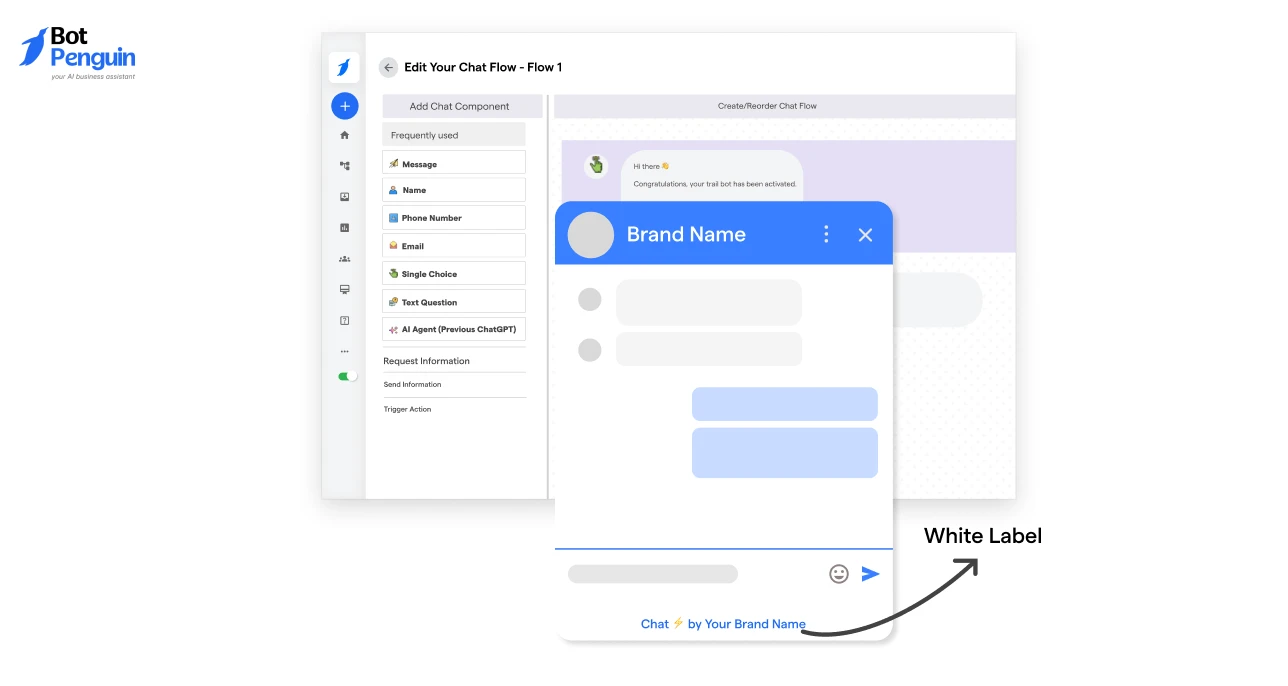
AI chatbots handle structured, FAQ-type conversations on websites and messaging apps.
They are simpler than AI agents because they are reactive rather than autonomous. This makes them faster to deploy, easier for clients to understand, and better suited to low-complexity setups.
In 2026, this category is best for agencies serving FAQ-heavy SMB clients that need simple support automation, website inquiry handling, and lead capture.
This category works best when agencies need:
- Entry-level automation for clients with high FAQ volume and limited budgets.
- A familiar solution that clients can understand quickly.
- A $100–300/month client offer for support, inquiries, and lead capture.
- Differentiation through branding depth, channel coverage, and CRM integration quality.
The white-label chatbot market is more crowded than the AI agent market, so these differences matter.
For a full overview of what to expect from a mature chatbot reseller program, see BotPenguin’s white-label chatbot platform.
3. White-Label AI Voice Software
AI voice agents handle inbound and outbound phone conversations autonomously.
They can book appointments, answer FAQs, and qualify leads. This makes voice AI useful for high-call-volume businesses with a measurable cost-per-call problem.
In 2026, this category is best for agencies targeting call-heavy businesses where missed calls, booking requests, and phone-based lead qualification directly affect revenue.
Agencies usually consider this category because:
- Voice automation is a high-margin niche because it is more complex than chat.
- It can often be packaged at $300–800/month for clients with higher call volume.
- It fits dental practices, service firms, call centers, and other phone-first businesses.
- Setup complexity is usually medium because voice flows need more testing, call logic, and fallback planning.
Platforms in this category include BotPenguin, VoiceAIWrapper, Synthflow, and others.
Agencies looking to add voice capabilities to an existing chatbot or agent service can explore BotPenguin’s white-label voice AI program.
4. White-Label AI Content Tools
White-label AI content tools generate marketing copy, blog posts, ad scripts, and email campaigns at scale.
Agencies use them to support client content services, such as ghostwriting, content calendars, and social media copy, without hiring additional writers.
In 2026, this category is best for agencies that already sell content retainers and want to increase output without expanding their writing team.
This category is most useful for agencies that:
- Already run content retainers for clients.
- Want to add AI speed to an existing service.
- Need a low-complexity add-on that can be packaged at $50–200/month.
- Need scalable content production without expanding the writing team.
However, margins are usually lower than AI agents because content tools are more commodity-like and face stronger pricing pressure.
Examples in this category include Jasper, Copy.ai, and Writesonic in white-label form.
5. White-Label AI SEO and Analytics Tools
White-label AI SEO and analytics tools help agencies deliver branded SEO reports, keyword tracking, and AI visibility insights.
These tools also help agencies monitor how AI search engines like ChatGPT and Perplexity mention client brands.
In 2026, this category is best for reporting-led agencies that need branded dashboards, keyword visibility, AI search tracking, and client-facing performance reports.
This category is becoming more important because:
- Agencies can deliver branded keyword reports, AI visibility reports, and client dashboards.
- It offers reporting-led agencies a low-complexity option priced at $100–400/month.
- The 2026 addition is AI Overview and LLM visibility tracking.
- Clients increasingly want to understand how their brand appears in AI-generated search answers.
BotPenguin adds value here by capturing conversation analytics, lead source data, and CRM-ready customer details from AI agent interactions. This gives agencies stronger first-party data to connect with their reporting workflows.
Platforms in this category include AgencyAnalytics, SE Ranking in white-label form, and newer AI-driven visibility-tracking tools.
Now, let's understand why white-label AI agents have emerged as the most valuable category and why agencies are prioritizing them.
Why White-Label AI Agents Lead the Category in 2026
Across the five categories, white-label AI agents deliver the strongest agency economics in 2026. They turn one platform cost into multiple client revenue streams while staying closely tied to daily client operations.
The following sections highlight the key factors driving their growth and profitability.
Fixed Platform Cost, Scalable Client Revenue
One partner plan can cover multiple client deployments.
The table below shows how agency revenue can scale when the average client retainer is $350/month, and the platform cost is $1,500/year.
This is why white-label AI agents can become attractive for agencies. Once the fixed platform cost is covered, each additional client can increase margin without requiring a new software build.
High Stickiness Inside Client Operations
AI agents become harder to replace once they are embedded in client workflows.
An AI agent connected to a client’s WhatsApp and CRM, handling regular customer conversations, creates measurable value and real switching costs.
Omnichannel Coverage From One Platform
One AI agent platform can support multiple agency service lines, including customer support, lead generation, appointment booking, and ecommerce automation.
They can also operate across multiple channels, such as website chat, WhatsApp, Facebook Messenger, Instagram, SMS, email, and voice.
This lets agencies create several client offers from the same platform at the same cost.
Expanding Category Demand
AI adoption among smaller businesses accelerated through 2025. The U.S. Chamber of Commerce reported that 58% of small businesses were using generative AI in 2025, up from 40% in 2024 and more than double the 2023 adoption rate.
This wider adoption gives agencies a larger market for practical, client-ready AI services.
That is why white-label AI agents lead the category. They sit closer to revenue, retention, and daily operations than most other white-label AI software categories.
Agencies ready to compare specific vendors can review the best white-label AI agent platforms based on branding, channel support, deployment requirements, and agency fit.
For a complete breakdown of platforms, use cases, pricing models, and deployment processes, see our white-label AI agents - the complete guide.
As the market for AI solutions continues to expand, the next question is which specific AI products agencies choose to resell. The following section discusses that in detail.
How Agencies Choose What to Resell
The right resale category should align with the client’s industry, primary communication channel, and first measurable use case.
Choosing white-label AI for agencies, therefore, begins with client demand rather than the longest platform feature list. That makes the first offer easier to explain, sell, and renew.
The decision matrix below shows which white-label AI software category best fits each client profile.
This framework helps agencies avoid choosing software only because it looks advanced. The better approach is to match the category to the client’s channel, use case, and willingness to pay.
Once that fit is clear, the next step is evaluating how agencies can profitably package and sell their chosen category.
What to Look For in Any White Label AI Platform
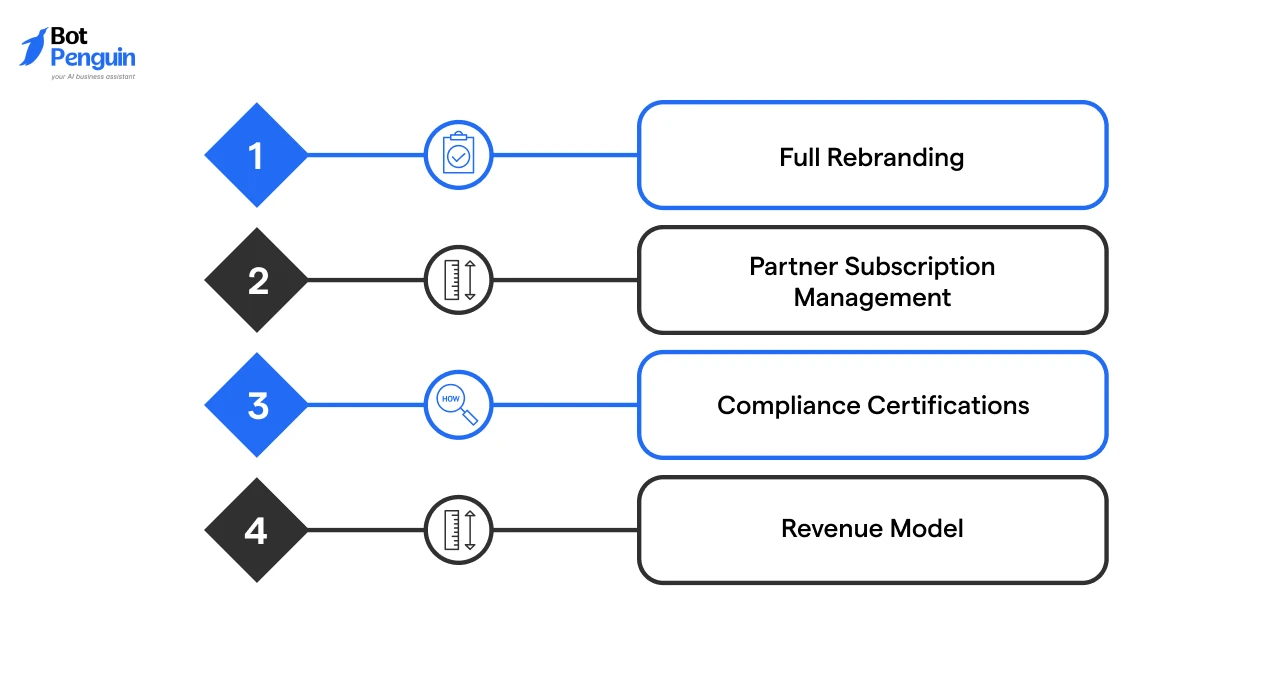
Regardless of category, agencies should evaluate a white-label AI platform against the following four core criteria. These decide whether the platform can support real resale, long-term client ownership, and profitable scaling.
Full Rebranding
The platform should support complete client-facing rebranding. That means your domain, logo, name, and brand identity should appear across all client touchpoints.
Adding a logo to the vendor’s interface is not full white labeling.
Partner Subscription Management
A strong platform should let you create and manage your own client plans. Look for support for:
- Custom pricing plans
- Free trials
- Client billing control
- Local currency payments
- Local payment gateways
This helps agencies package AI software as their own subscription product.
Compliance Certifications
Compliance matters when clients operate in regulated industries. Agencies should verify each provider’s privacy controls, certifications, security assessments, and industry readiness before signing a contract.
BotPenguin is GDPR-, HIPAA-, and CCPA-compliant, ISO-certified, SOC 2-attested, and VAPT-assessed by a CERT-In impaneled auditor.
Request written documentation from any shortlisted provider before offering the platform to healthcare, finance, or other regulated clients.
Revenue Model
The revenue model directly affects agency margins.
A flat annual fee with 100% revenue retention usually beats commission-based or revenue-sharing models once client volume grows.
Run the numbers at 5 clients and again at 20 clients. The better model becomes clearer at scale.
With the evaluation criteria clear, agencies can move from platform selection to landing their first client. Let's see how in the following section.
Getting Started: The Fastest Path to Your First Client
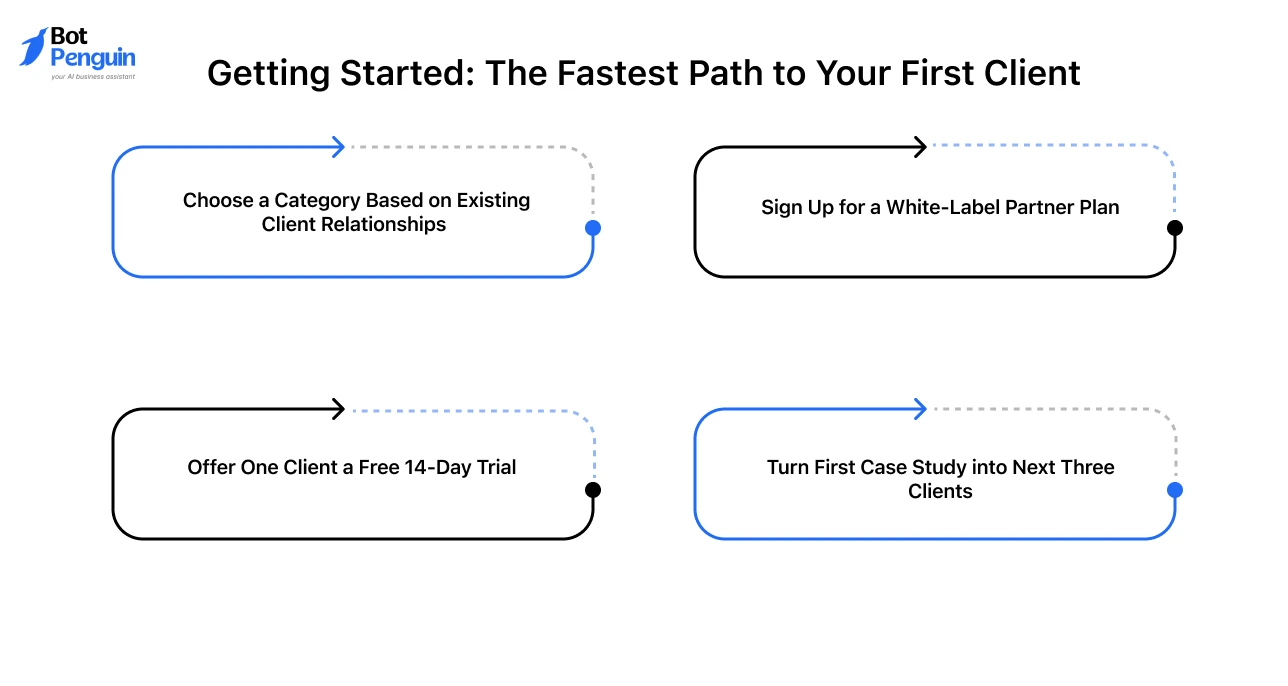
The fastest path is to start with an existing client, solve one focused problem, and prove value quickly.
Follow these four steps to launch and resell AI software under your brand.
1. Choose a Category Based on Existing Client Relationships
List every current client who has a measurable problem with any of these: slow lead response, high support volume, missed appointments, or poor WhatsApp coverage. These are the first deployment candidates.
Do not start with a new prospect; start with someone who already trusts your agency. The category they need determines which platform you sign up for.
For most agencies serving clients in MENA, India, LATAM, or Southeast Asia, the best white-label WhatsApp AI agents are the starting point. For UK or US agencies with website-first clients, website chat AI agents or chatbots are a faster entry point.
2. Sign Up for a White-Label Partner Plan
For AI agents, BotPenguin’s white-label partner program includes your branded platform - your domain, your logo, your client interface. Setup takes under 12 hours from signup to a live branded dashboard.
Plans start at $1,500/yr and cover unlimited client deployments. You do not need to commit to a specific number of clients upfront.
The first client’s retainer typically covers the platform cost within 1 to 3 months, depending on your pricing.
3. Offer One Client a Free 14-Day Trial
Choose one specific workflow — support ticket deflection, WhatsApp lead qualification, or appointment booking. Do not try to deploy everything at once.
Configure and go live in the first 2–4 hours. Spend week one monitoring conversation logs daily and retraining on failed queries. By day 14, you have enough data to show the client a before-and-after: tickets handled automatically, leads qualified, appointments booked without phone calls.
Present the 14-day results and convert to a monthly retainer. Clients who see results within 14 days rarely cancel.
4. Turn First Case Study into Next Three Clients
Document the result specifically: 40% fewer support tickets in the first 30 days, or 12 appointments booked without a single phone call in week one.
Specific numbers close faster than general AI promises. Two case studies with real outcomes are enough to begin outreach in your niche.
Referral from the first client — asking for an introduction to one other business they know — is faster than any cold outreach and should be requested at the end of month two, once the client has seen consistent results.
Start small, validate results quickly, and scale successful deployments into recurring revenue.
Frequently Asked Questions (FAQs)
What is white label AI software?
White-label AI software is prebuilt artificial intelligence technology that agencies and businesses rebrand and resell under their own names. The underlying platform is developed by a vendor; the agency customizes the branding, sets its own pricing, and manages client relationships — the vendor stays invisible. Categories include AI agents, chatbots, voice AI, and content tools.
What is the difference between white label AI software and white label AI products?
There is no practical difference between the terms. White-label AI software usually refers to the underlying platform an agency rebrands, while white-label AI products refer to the agents, chatbots, voice tools, or content tools it resells. Both let agencies sell ready-made AI under their own branding and pricing.
What types of white label AI software can agencies resell?
Five main categories: (1) AI agents: autonomous workflow automation across WhatsApp, website, and social; (2) AI chatbots: conversational FAQ and lead capture tools; (3) voice AI: automated phone and voice channel agents; (4) content AI: writing, copywriting, and SEO content generation tools; (5) AI SEO and analytics tools: reporting and optimization dashboards.
Which white label AI software is most profitable for agencies?
White-label AI agents deliver the highest margins for most agencies: platform costs are fixed (from $1,500/yr), client pricing runs $200–600/month, and once deployed in a client's workflow, the service is highly retained. AI chatbots are profitable for high-volume SMB clients. Voice AI is high-margin but serves a narrower market.
Can agencies white label AI software without technical expertise?
Yes. Modern white label AI platforms are no-code by design. BotPenguin's partner dashboard lets agencies deploy AI agents for clients across WhatsApp, website, and social channels without writing code. Setup typically takes 2–4 hours per new client using a template workspace.
What should agencies look for in white label AI software?
Four criteria matter most: (1) full rebranding — your domain, your logo, not the vendor's; (2) omnichannel deployment — WhatsApp, website, and social from one platform; (3) partner subscription management — create your own pricing plans and bill clients in local currency; (4) compliance certifications — GDPR, HIPAA, CCPA for enterprise and healthcare clients.
How much does white label AI software cost?
Pricing varies by platform, features, channels, and billing model. BotPenguin’s white-label plan starts at $1,500 per year and covers unlimited client deployments. Because the platform uses a flat annual cost, agencies can increase their margin as they add more clients without paying for a separate deployment plan each time.
Conclusion
White label AI software now spans five major categories and dozens of platforms.
For most agencies, the most important decision is not which specific tool to use first. It is choosing the category that fits their clients, communication channels, and operational model.
Once that is clear, the choice of platform becomes much easier.
In 2026, white-label AI agents offer one of the strongest combinations of margin, client stickiness, and growing demand. The category is expanding. The technology is ready. Client conversations around AI are also easier than they were 12 months ago.
The remaining step is to start with one clear use case, one trusted client, and one measurable result.
