

Building a chatbot from scratch can cost anywhere from tens of thousands to over $200,000 and take months or even years to develop.
Most founders don’t have the time or capital for that.
Now imagine, you could launch your own AI chatbot solution in just weeks, without the huge upfront costs.
White label chatbots make that possible. They allow you to customize and sell AI solutions without the need for technical expertise or massive investments.
In this guide, you’ll learn what a white label chatbot is, how it works, and how it can help you scale your business quickly and efficiently.
What is a White Label Chatbot? A Simple Overview
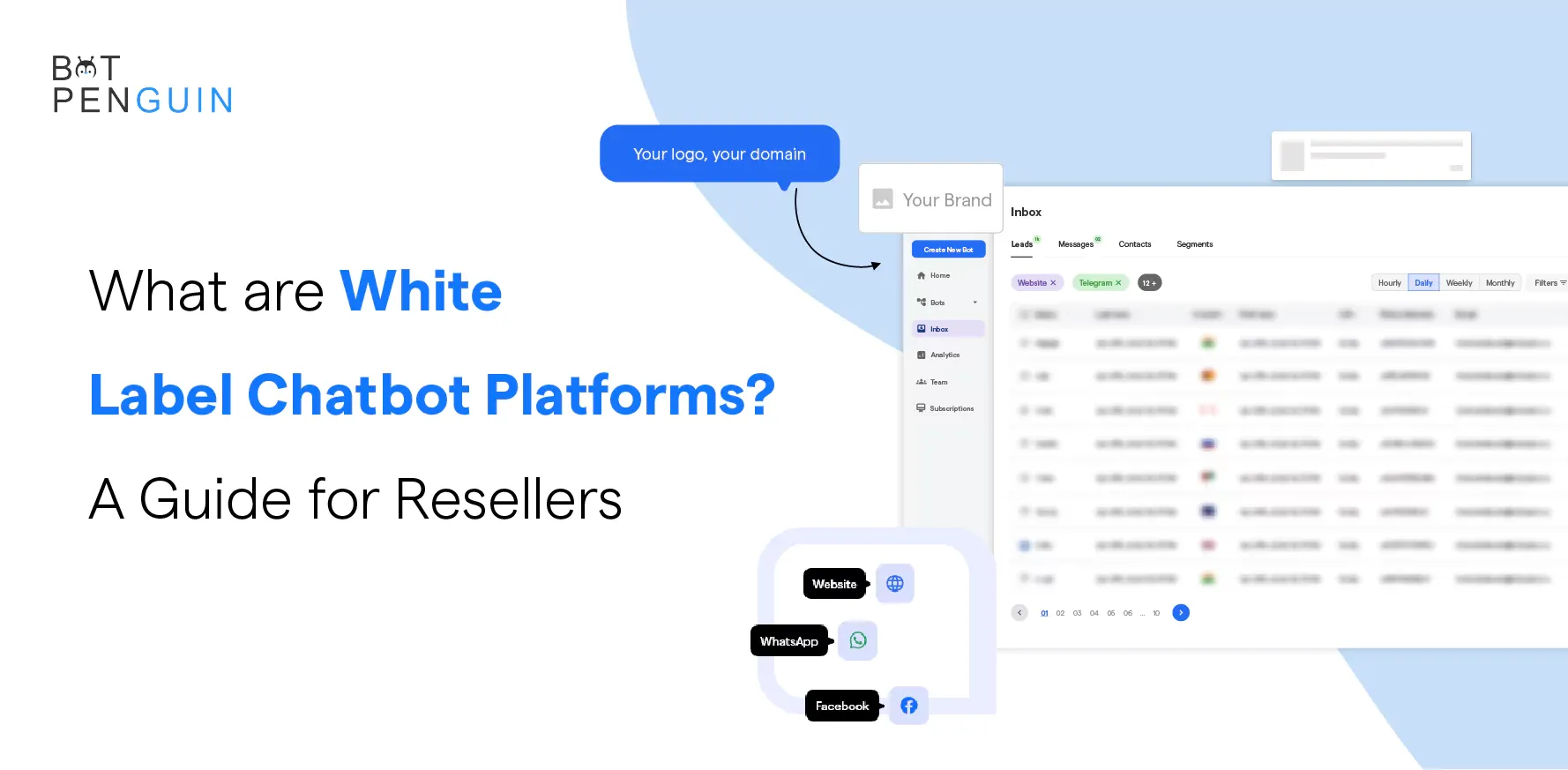
A white label chatbot is an AI chatbot built on an existing platform, then customized and sold to clients under your own brand name.
For example, a digital marketing agency could offer a branded chatbot to clients for handling customer inquiries, without developing the technology itself.
Here’s the typical flow for easy understanding:
- Platform Provider → Builds the chatbot
- You → Customize the chatbot (branding, conversation templates, etc.)
- You → Sell the chatbot to clients under your brand name
- Client → Uses the chatbot for customer interactions
Thus, white label chatbots provide an easy and cost-effective way to offer advanced AI solutions to your clients without the need for extensive development.
Why White Label Chatbots Make Sense for Most Founders
Grand View Research reports that the global chatbot market is projected to grow up to USD 41,244.2 million by 2033.
That growth is not happening in enterprise headquarters, but in small businesses across every industry and every region of the world.
Here’s why white label chatbot makes sense for you as an entrepreneur:
- Cost-Effective: By their very nature, these chatbots save you $50,000-$150,000 in development costs and reduce time by months.
- Faster Time to Market: You can launch your branded white label AI chatbot in weeks instead of waiting 12 to 18 months.
- Focus on Growth: You can focus on building relationships and growing your business, while the platform handles the technical side.
- Scalable: It’s possible to easily add clients without significant additional costs or resources, enabling rapid growth.
At this stage, it’s worthwhile understanding in detail how the entire process works. By choosing white label chatbots, you can skip the technical hurdles and focus solely on brand management.
How a White Label Chatbot Works: The Process Behind
A white label chatbot works by combining ready-made AI technology with your own branding.
Instead of building the system from scratch, you use an existing platform and sell it as your own solution while the provider handles all the technical work.
Core Components: What Powers the Product
Here are the three core components that power the white label chatbot:
All of these components are built and maintained by the platform provider, freeing you from technical complexities.
Underlying Mechanism Behind a White Label Chatbot Interaction
When a customer interacts with a white label chatbot, the process works as follows:
1. Message Reception: The message is received through the channel layer (e.g., WhatsApp, website widget).
2. Intent Recognition: It’s passed to the NLP engine, which identifies the intent (e.g., booking, checking order status).
3. Routing: The chatbot routes the message to the appropriate conversation flow based on the identified intent
4. Response: A relevant response is returned to the customer, usually within two seconds.
Additionally, API connections that pull live data (e.g., from booking systems, Shopify, etc.) are easily configured through the platform’s visual integration interface.
Key Roles in White Label Chatbot Deployment
There are four key roles involved in a white label chatbot deployment:
These roles ensure a smooth process for deploying and managing white label chatbots.
If you'd rather skip the heavy lifting, explore BotPenguin to scale chatbot experiences effortlessly and deliver powerful, customizable results without the hassle.
White Label Chatbot vs Building In-House: Key Differences and When to Use Each
For founders evaluating how to enter the chatbot market, the choice almost always comes down to white labelling versus building proprietary technology.
The comparison table below makes the rational decision clear.
When white labelling is the right choice:
- You have identified a specific niche or regional market that generic global platforms do not serve.
- You do not have a technical founding team or the capital to build proprietary technology.
- You want to generate monthly recurring revenue from a SaaS product within weeks, not years.
- You are an agency owner adding a product line alongside your existing service business.
When building in-house might make sense:
- You have proprietary AI training data that creates a genuine, defensible technical moat white labelling cannot replicate.
- You have a well-funded engineering team and a roadmap that genuinely requires custom infrastructure.
- Your use case is so specific that no existing platform can support it even with deep configuration.
For the vast majority of founders entering the chatbot market, the AI chatbot white label route reaches the first client in a fraction of the time at a fraction of the cost.
Where White Label Chatbots Fit in Founder and Agency Workflows
From market research to client retention, white label chatbots streamline each stage, allowing founders to focus on growth without getting bogged down by technical challenges.
Here’s a clear breakdown of how white label chatbot solutions help founders grow their business:
The platform handles the infrastructure across every stage. The founder handles the market, the client and the narrative that makes the product worth paying for month after month.
Key Use Cases of White Label Chatbot Platforms
The most profitable white label chatbot businesses serve a specific niche, not a broad market, where the founder already has credibility and generic platforms have consistently failed to deliver.
Targeted Niche Markets
Focusing on a specific niche like healthcare, e-commerce, or real estate allows you to tailor the chatbot to solve unique industry problems, improving value for clients.
Example: A chatbot platform that focuses on law firms helping them with client intake forms, legal consultations, and appointment scheduling.
Localized Solutions
White label chatbots can be customized to support regional languages and specific cultural needs, addressing gaps that global platforms don’t cater to.
Example: A Hindi-language chatbot for small businesses in India can automate sales inquiries, boosting engagement in underserved markets.
Industry-Specific Customization
Create chatbots that understand complex workflows within industries like healthcare or finance, which generic chatbots often fail to address.
Example: A chatbot for financial services can securely handle loan inquiries, process document uploads, and guide users through compliance steps.
Customer Support Automation
Automating customer service with white label chatbots enhances user experience and reduces operational costs, without compromising personalization.
Example: An e-commerce store can deploy a chatbot to answer FAQs, track orders, and manage returns, freeing up support teams to handle complex issues.
These use cases share a structural advantage: the founder already has the market relationship, the industry credibility and the niche knowledge. The white label chatbot platform provides the technology layer that converts that knowledge into a scalable software product.
Real Benefits of White Label Chatbots
Adding a white label chatbot changes the economics of your business: what you can build, how fast you can build it and how defensible the position becomes over time.
Here are the top benefits of using these solutions:
- No Development Costs: Skip $50,000-$200,000 in development costs. Focus your budget on client acquisition and niche positioning.
- Quick Launch: Get a branded AI chatbot live in 2-6 weeks, not years, and start generating revenue fast.
- Recurring Revenue: Each client generates monthly subscriptions, compounding with every new client.
- Scalable Growth: Add clients with minimal extra costs; your platform scales automatically.
- Automatic Updates: Receive platform improvements (e.g., new channels, NLP upgrades) without additional investment.
- Market Positioning: Focus on underserved markets with minimal competition, creating a strong competitive edge.
These benefits reflect how white label chatbots can elevate your business position.
With BotPenguin, you can take advantage of all these merits and more, offering powerful, customizable chatbot solutions without the heavy development overhead.
Challenges and Limitations of Running a White Label Chatbot Business
The technology barrier in a white label business is low. The business barrier is not.
Understanding where the real challenges sit prevents the most common failure modes before they become expensive.
Client Acquisition Without an Established Brand
A new white label chatbot business lacks case studies and a proven reputation, making it difficult to convert niche credibility into paying clients.
Solution: Start with clients you already know. Leverage your professional network, industry contacts, and online communities to build trust.
Setting Client Expectations About What White Label Means
Clients may confuse white label chatbots with proprietary technology, leading to trust issues if not managed correctly.
Solution: Position white label chatbots as standard industry practice and focus on the results, not the technology behind it.
Platform Dependency Risk
Relying on a third-party platform means changes in pricing, features, or service availability can impact your business.
Solution: Evaluate platform stability before committing and choose providers with transparent pricing and active development.
Competing Against Free or Low-Cost Generic Chatbot Tools
Price-sensitive clients may question why they should pay for a solution when free tools are available.
Solution: Compete on specificity. Offer pre-configured solutions for niches (e.g., dental, e-commerce) that free tools can't match.
Retaining Clients in the First 90 Days
The first 90 days after onboarding are critical, and clients who don’t see quick results are at high risk of churning.
Solution: Develop a structured first-90-day process with clear milestones, performance reports, and measurable outcomes to keep clients engaged.
Every one of these challenges is navigable. The founders who fail at white label chatbot businesses do not fail because the technology broke.
They fail because the business fundamentals were not treated with the same seriousness as the product launch.
What to Consider Before Adopting a White Label Chatbot Platform
Before committing to a white label chatbot platform and a target niche, six factors determine whether the timing and the configuration are right.
These six factors replace months of trial-and-error with an afternoon of honest assessment. Founders who work through them before choosing a platform save themselves the most expensive mistakes the business will face.
Metrics to Evaluate Your White Label Chatbot Business
Tracking the right metrics makes renewal conversations straightforward and identifies which parts of the business need attention before clients start asking the same questions themselves.
Here are the top metrics to track:
Remember: Tracking these metrics from day one helps you stay on top of performance and make data-driven decisions that keep your clients satisfied and your business growing.
What’s Next for White Label Chatbots
Looking ahead, three technology directions will define what these products can deliver next and which markets they can reach.
Multimodal AI Expanding What a Chatbot Can Handle
Chatbots are evolving into multimodal AI agents, processing images, voice, documents, and data. This shift will make multimodal capabilities standard for SMBs, removing the need for additional engineering.
Hyper-Local Language Models Reaching SMB Price Points
Global chatbot investments are shifting towards regional languages, like Hindi and Arabic, improving NLP quality. White label platforms can now offer high-quality, localized solutions without extra maintenance costs.
Agentic AI Replacing Scripted Conversation Flows
Future chatbot platforms are moving from scripted flows to agentic AI, handling complex, adaptive conversations. Founders will focus on defining goals and escalation, while platforms manage AI complexity.
Overall, the future of white label chatbots lies in expanding capabilities, offering localized solutions, and adapting to more intelligent, context-aware interactions.
Final Thoughts
White label chatbots are an easy, cost-effective way to dive into the chatbot market without the need for complex tech work.
By targeting niche markets, you can offer tailored solutions that truly help your clients. As the technology keeps improving, these chatbots will become even more flexible and accessible.
Whether you want to automate customer support or provide specialized tools, white label chatbots can be a game-changer for founders and agencies.
With the right platform, you can grow your business quickly, focusing on what really matters, building relationships and driving growth.
Frequently Asked Questions (FAQs)
What is a white label chatbot?
A white label chatbot is an AI chatbot built on an existing platform and sold to clients entirely under your own brand name, logo and pricing.
How much does a white label chatbot platform cost?
White label chatbot platform fees range from $200 to $500 per month. You set your own retail price and keep the margin above that cost.
Can I use a white label chatbot for WhatsApp?
Yes. Most white label chatbot platforms support WhatsApp Business API, allowing you to sell WhatsApp automation to clients under your brand.
How is a white label chatbot different from reselling?
A white label chatbot is fully rebranded as your product. A reseller arrangement means clients know they are using a named third-party platform.
Do I need coding skills to run a white label chatbot business?
No. White label platforms use visual builders for all configurations. The skills required are business understanding and client management, not coding.
Which industries work best for white label chatbot businesses?
Healthcare, education, real estate, eCommerce and hospitality work best due to high conversation volume and clear, measurable automation ROI.